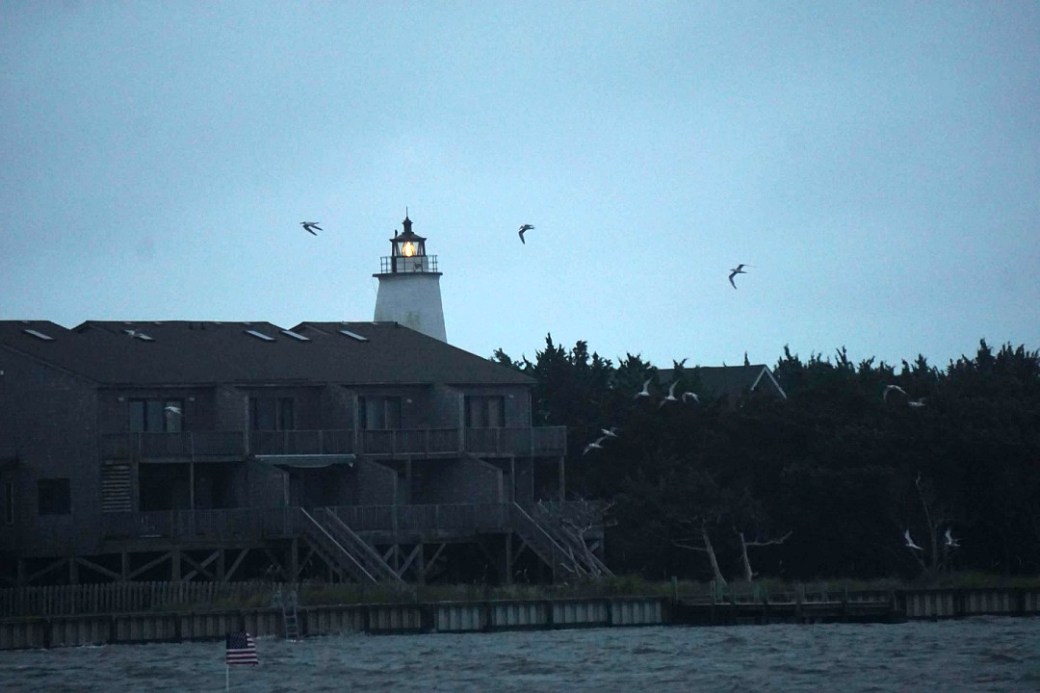
 Since 1823 the Ocracoke Lighthouse has been lighting the way for sailors, and it is a vital part of what makes up Ocracoke today. Not only is it one of the first things visitors to the island want to see, it is part of many of the stories that tell the history of the island and the village. I have been here a little more than eight months now and have tried to learn all I can about the island and its people. Locals and those who are more seasoned “dingbatters” (more on that later) than I have welcomed me with open arms and stories, smiles, greetings, encouraging words. I have read books written by islanders and walked the streets of the village as well as many, many miles on the beach. Here is some of what I have learned about the village and its people.
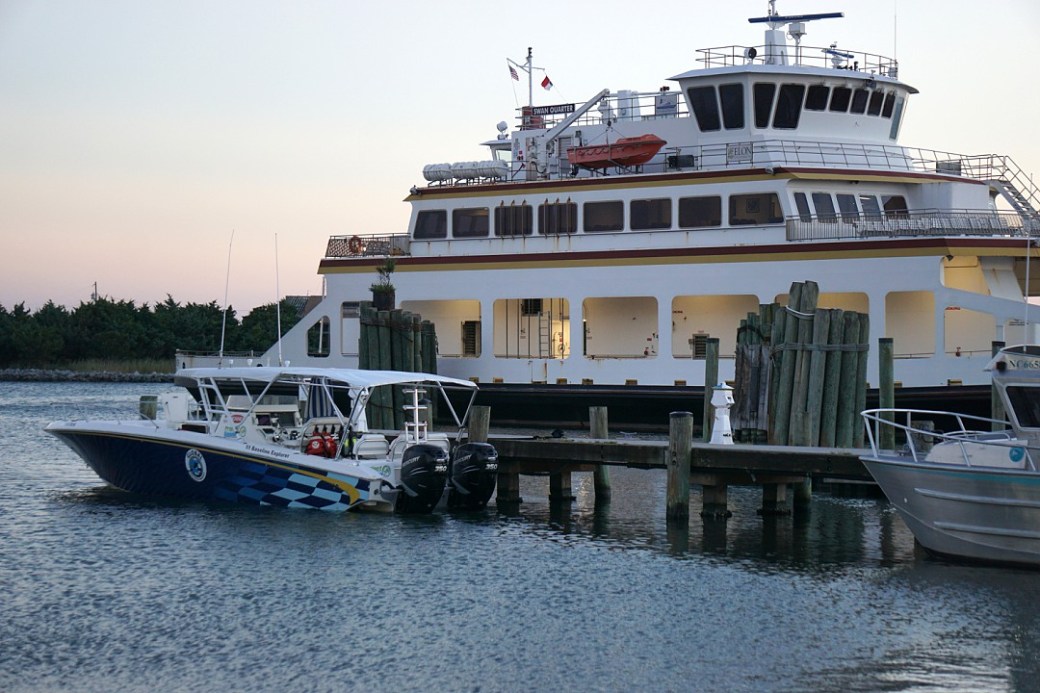 Perhaps the most important first fact is how dependent Ocracoke is on the ferry system. One cannot get on or off the island without a boat, generally a ferry — assuming you want to take your car so you can get somewhere once you disembark! (There is a small airstrip, but that is hardly a viable option for most folks!) And of course travel by ferry is dependent not only on the schedule itself but also on the whims of the water, the effects of wind and tide on the water levels and the amount of sludge in the sounds. And then there is the possibility of a long line waiting for a ferry, especially during the busier seasons of the year (roughly April through September!).
Since I am teaching here, I see the impact of the ferry on our school. Most doctor and all dentist/ orthodontist appointments require a student (or teacher) to miss a full day of school. The same is true for travel to away games for our athletic teams. It isn’t unusual for a team to get back to the island as late as midnight. And more than one game has been ended on a questionable call by a referee or umpire who wanted to be sure he caught the last ferry!
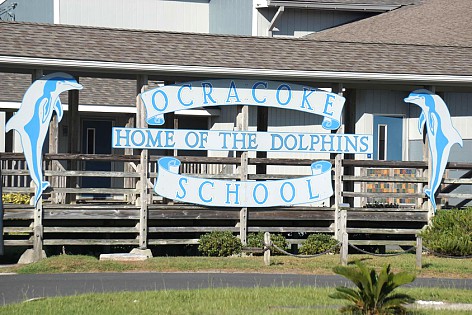
The community is so involved in the school! The turnout for athletic events, food fundraisers, plant sales, arts performances, everything is amazing. And in turn the school is a huge part of the community. When a house caught fire recently, several teachers and students had to leave to help fight the fire. This is Run Fest weekend and students were working stations all along the routes. All high school students are required to log at least ten hours of community service each year, and most far exceed that number.
And the school itself is so special, so different. In many ways it is like any other school: teachers, students, projects, tests. We have STEAM Fair and Battle of the Books, state testing, ESL and EC, after school program. We don’t have a cafeteria or buses or bells. Children ride their bikes to school or walk; a few are dropped off by parents in golf carts or cars. They use that same transportation to go home for lunch or they stay at school and eat food brought from home (or sometimes delivered by parents!). And when they finish eating, they go outside and play! When the principal has a chance, he goes outside with them to play football.
Football… there is no football on Ocracoke, outside of those playground games. Basketball is popular and successful here. It has long been the game of choice. Soccer and baseball programs are growing. And not having football even changes the concept of homecoming! I’ll write more later about the interesting traditions of homecoming, prom, graduation, and so on.
We have no bells at school because of the size of the campus. Ocracoke School includes pre-kindergarten through 12th grade. The elementary, middle and high schools all have different schedules– except for lunch, which is the same for everyone– so we cannot have bells ringing all day long! everybody either brings lunch (or parents bring it to the children!) or goes home for lunch. And after lunch, the playground is full of running, ball-throwing, giggling children.
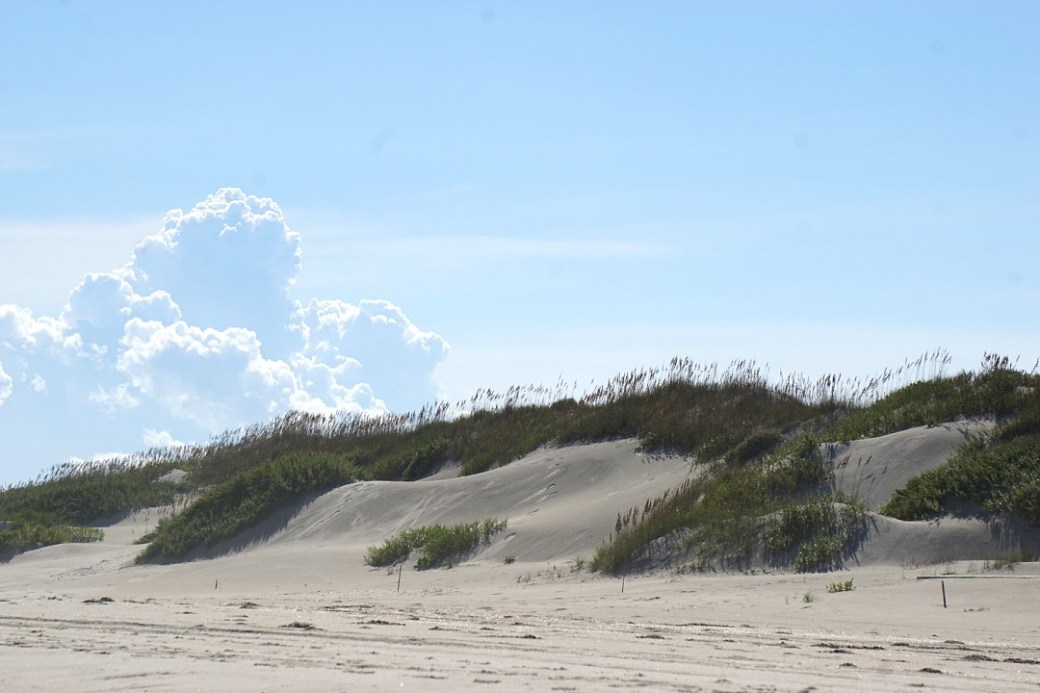 Almost every day after school, I head to the beach to walk. I walk for exercise; I walk to look for shells; I walk to observe and photograph birds. And I walk to clear my mind, to pray, to meditate, and to think. And one of the things I think about it the dunes. All my previous experience on NC and SC beaches have included warnings to “keep off the dunes”! Here people can regularly seen climbing the dunes or walking between them from pull-out spots alongside Highway 12. And from my reading of local books, I cannot help but wonder which of these magnificent sand piles are built up around abandoned cards from the early 20th Century and within which dunes are hidden the bones of shipwreck victims from even earlier. This is part of the wonderful history of the island. When cars stopped working, after being “driven to death,” and the inevitable rust and corrosion from the salt took over, there was no place to leave them. Some were left sitting in yards and some were simply abandoned wherever they stopped running along the main road, left for sand to blow and build up around them. And despite the faithful lighthouse, many shipwrecks still occurred and many lives were lost. Ocracokers were quick to come to the aid of the floundering ships, and they carefully tended to the bodies of the those who lost their lives. Some were wrapped in cloth from the ships or whatever other material could be found and then buried in the dunes.
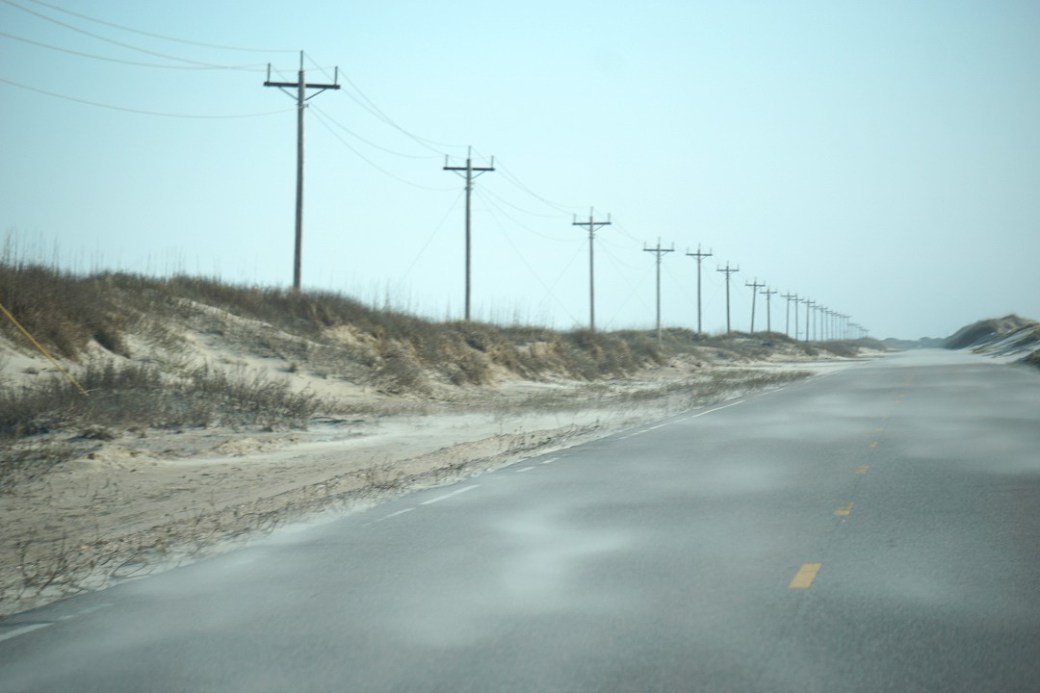 Speaking of Highway 12, here is a look at it as I drove to the ferry on the north end, leading to Hatteras Island and, among other things, the nearest chain grocery store. Notice the sand blowing across the road. Typical. Often there is a plow parked on the side of the road… I am used to thinking of this as a snow plow. Not so much here! Highway 12 runs the length of the Outer Banks. On Ocracoke it begins and ends at ferry terminals. Within the village it is know as Irvin Garrish Highway, and most of the retail establishments as well as other vital elements of the community (school, churches, fire department, etc.) are either on the road or located a “block” off it. NC 12 is often covered in sand or water. Big storms can leave it impassable for days.
I come from the mountains. We have trees. Lots of trees. Big trees, little trees, bushes. We love our trees and all their foliage. Especially in the fall when the leaves turn amazing colors (sometimes). Here on Ocracoke there are not as many trees or as much variety. But two varieties stand out: the live oak and the fig. Live oaks are salt tolerant and sturdy enough to withstand the often harsh winds. Many magnificent oaks have survived for hundreds of years here. And the fig provides those luscious fruits which are made into preserves which then become the island’s signature dessert, the Fig Cake. It is really simply a jam cake which is made in many locales with various fruit preserves, but here it is truly a legend. (With a little luck, I will be entering my own variation of the Ocracoke Island Fig cake at next year’s Fig Festival.)
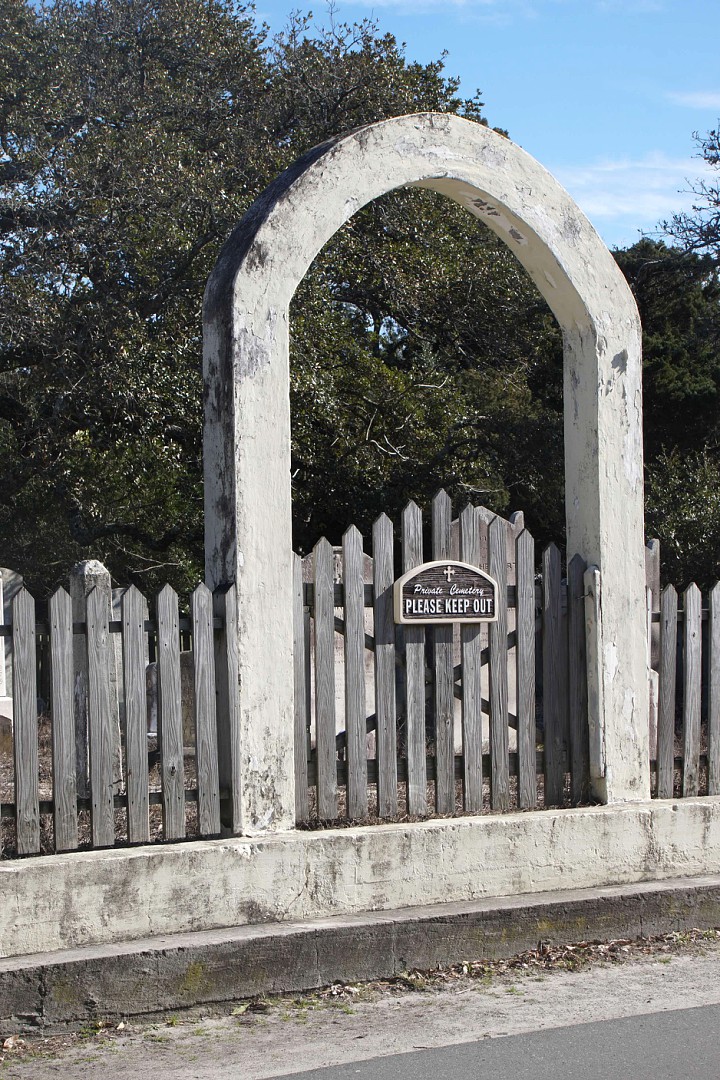
Small family cemeteries can be found all over the village. Some of the gravestones are so old and worn that the script is unreadable. Others reveal some interesting information. There is the Wahab family who lost several young sons, including one whose stone indicates that he dies before he was born. This was likely an engraving error that was too difficult and expensive to correct! The same cemetery has the grave of a woman who died in 1841 at the age of 117! Small family plots with names one sees and hears often on the island– Howard, Garrish, Styron, O’Neal, Gaskins– show up on Howard Street and in other unexpected places, in back yards, on paths and roadways throughout the village. A larger community cemetery now exists in the village as well.
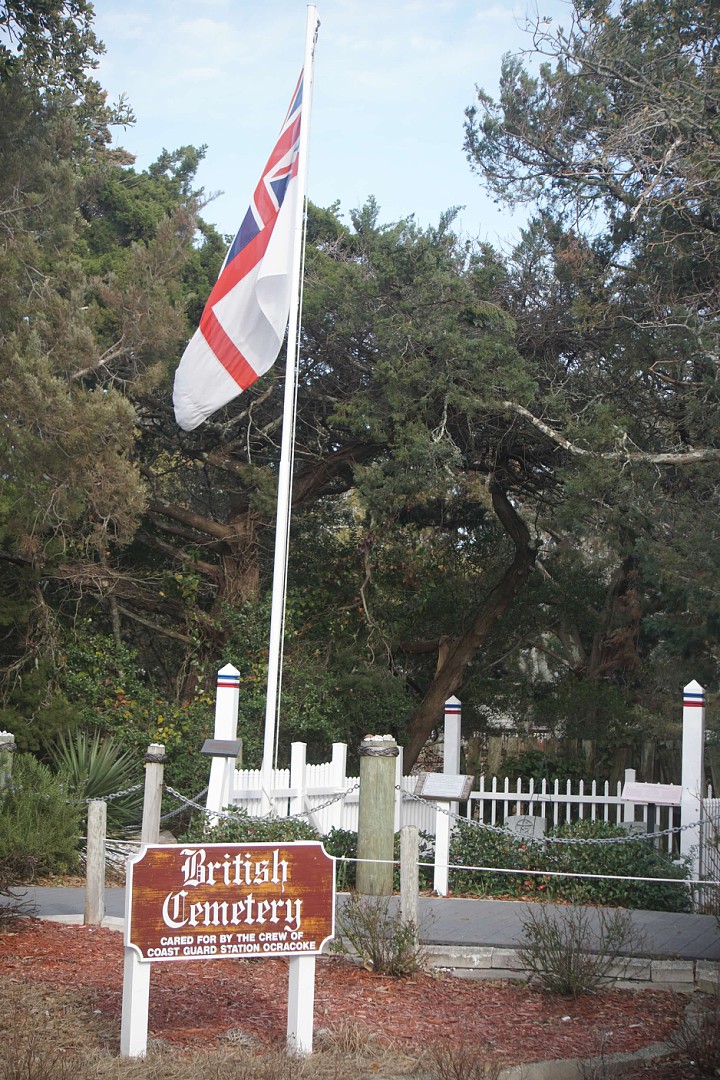
The British Cemetery is a source of pride in Ocracoke. It includes the graves of four British sailors and is dedicated to the memory of the HMT Bedfordshire of the British Royal Navy which was sunk by a German submarine in May, 1942. The four bodies that were recovered are buried in carefully tended graves, and a ceremony is held each spring to honor the fallen sailors and their contributions to our cause during WWII.
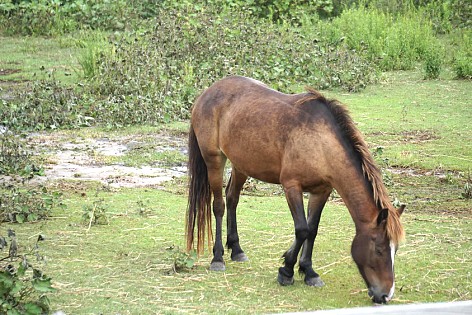
Ocracoke is known for its ponies. For over two hundred years they roamed freely on the island. The paving of Highway 12 and the increase in traffic led to concerns about the safety of the ponies, and in 1959 the National Park Service built fences to enclose the ponies in the Ocracoke Pony Pens. Just this month a new pony was born into the herd… expect a post about Jobelle soon. In the 1950s, Ocracoke had the only mounted Boy Scout troop in the country.
This post is taking me forever it seems! There is so much more to share, so many more things that are part of what makes Ocracoke the special place that it is. I shall change th title of this post to include “part 1” and will continue it later. Suffice it for now to say that I have come to love this place and have a deep appreciation for its culture, its history and its people.
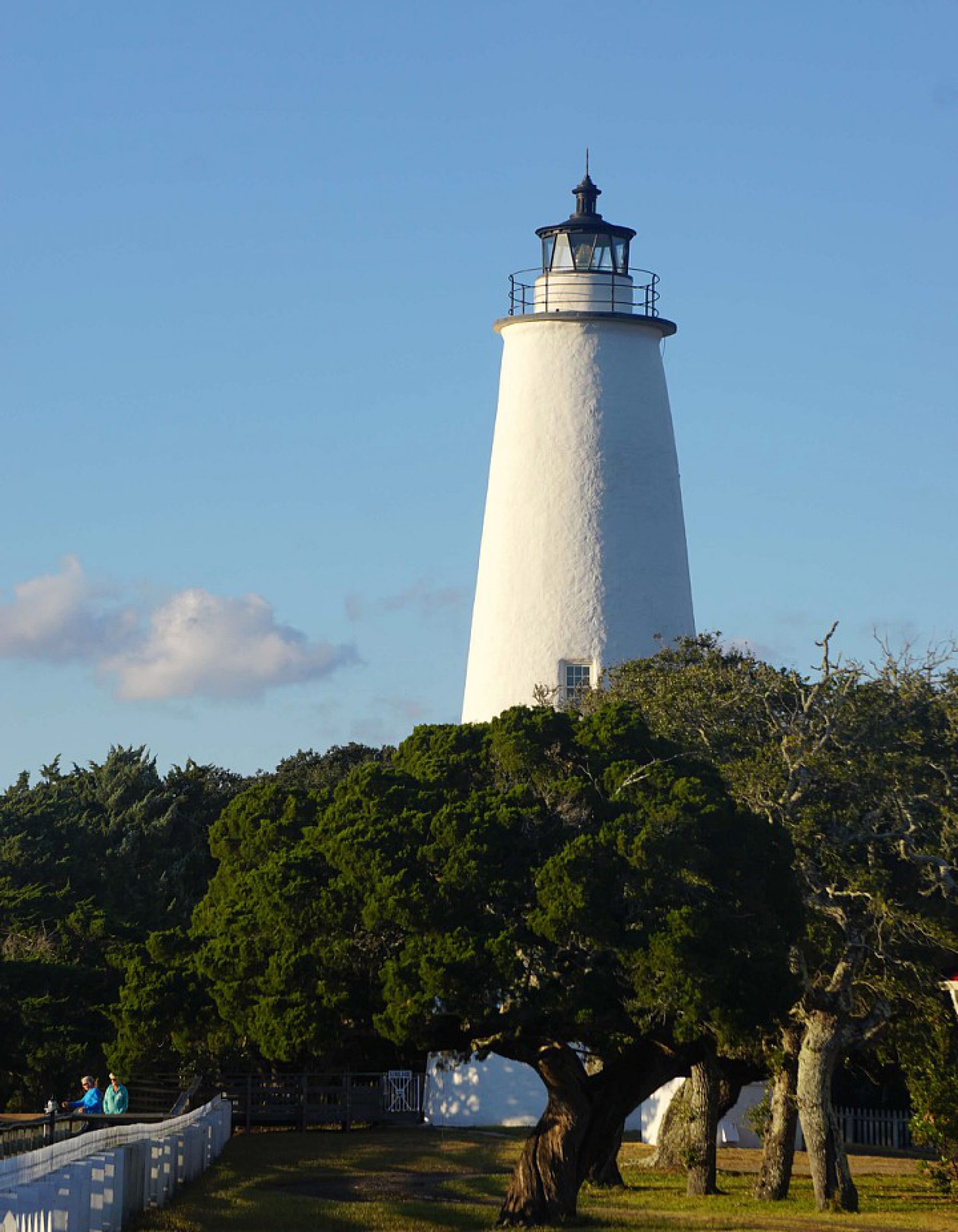


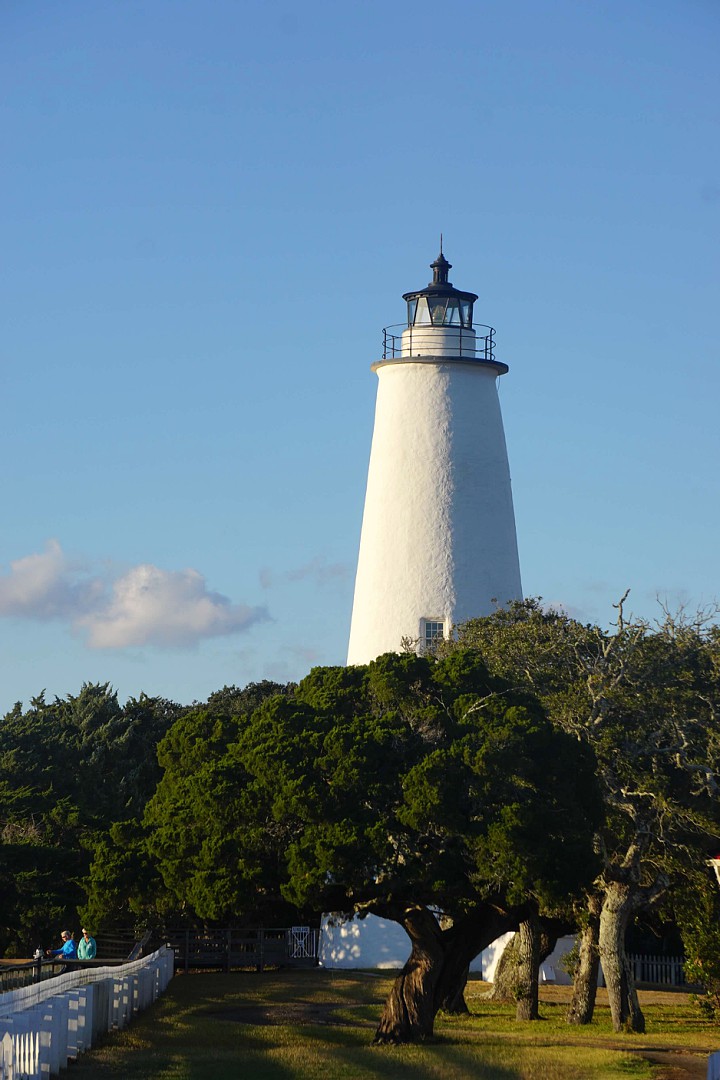 Nine months ago today I arrived in Ocracoke to begin this great adventure. (I had a trial run in June, staying in the house and getting to know the island and the village.) From the very beginning, I decided to immerse myself in the culture and the history and the lifestyle of Ocracoke. What an amazing ride it has been.
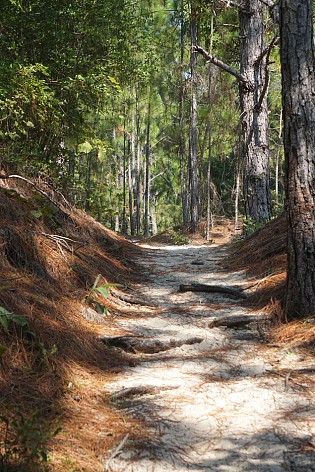 In my walking every day, places like Hammock Hills and Springer’s Point and, of course, the beautiful beach are part of my regular route. And in my walking, I pass the homes of my students and frequently meet them on their bikes, golf carts or (occasionally) cars or playing in their yards. I also run into parents and members of the community. An impromptu parent conference on the side of the street or at the post office is not uncommon. And since far more people know my name than I know theirs, folks will frequently call out to me and ask how it is going. I recognize them from where I met them or who introduced us or some other connection, but I do not always know names to go with the faces.
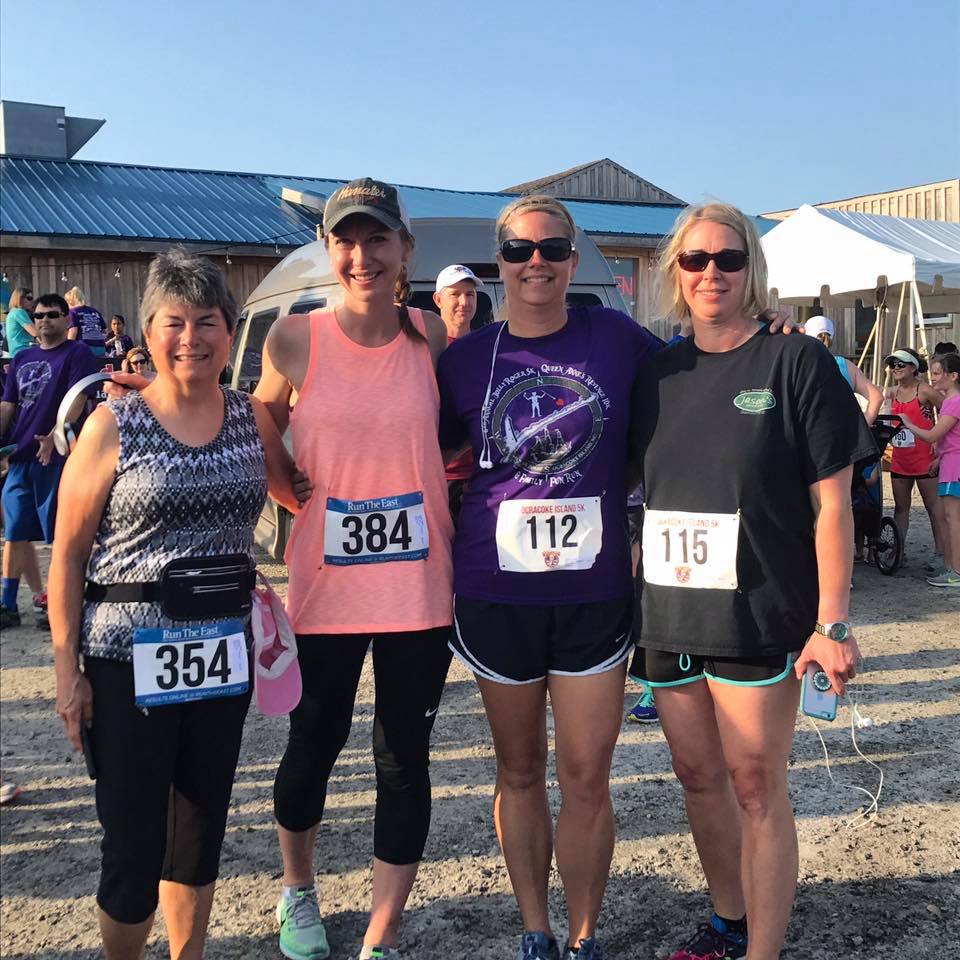
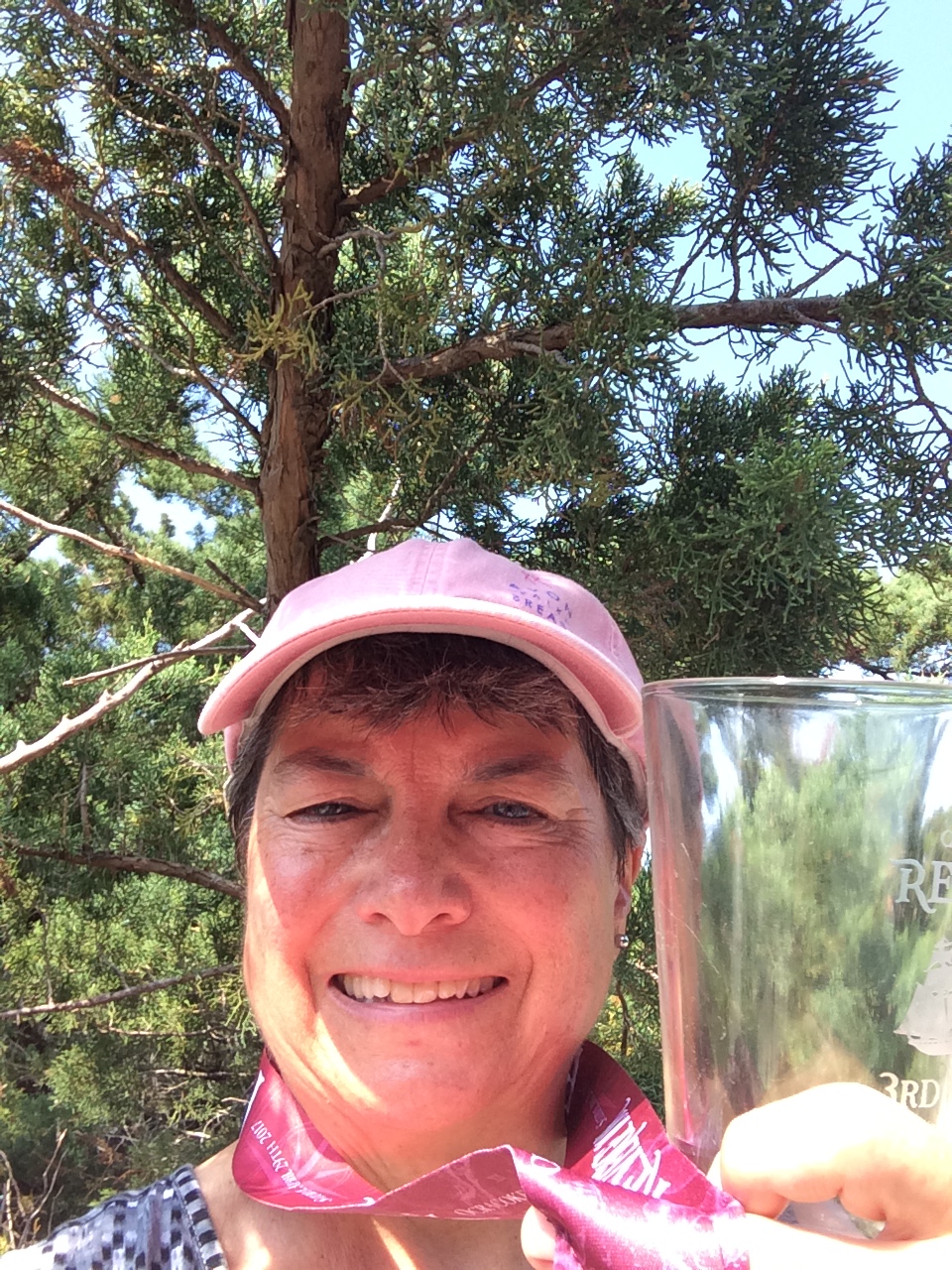
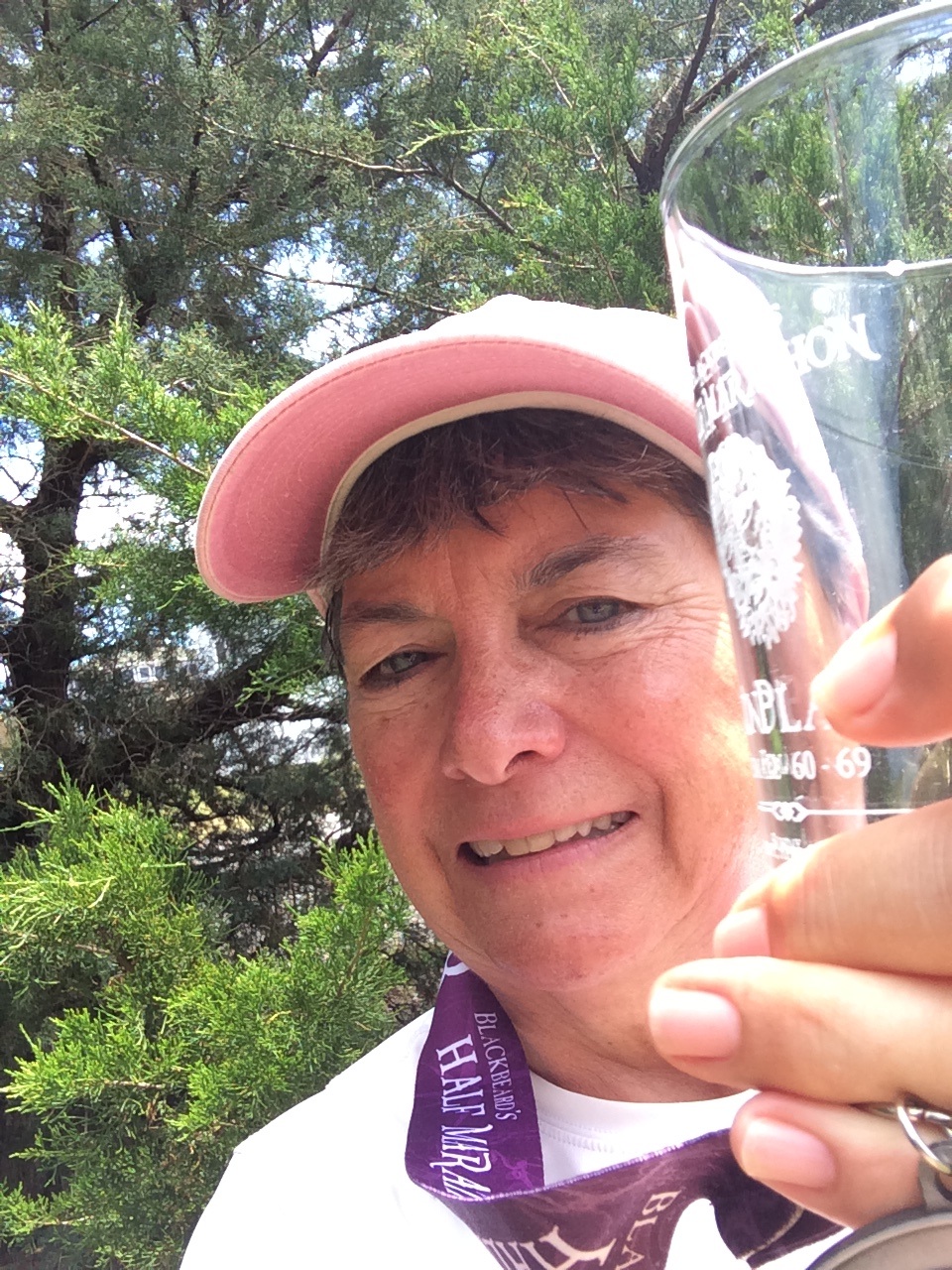
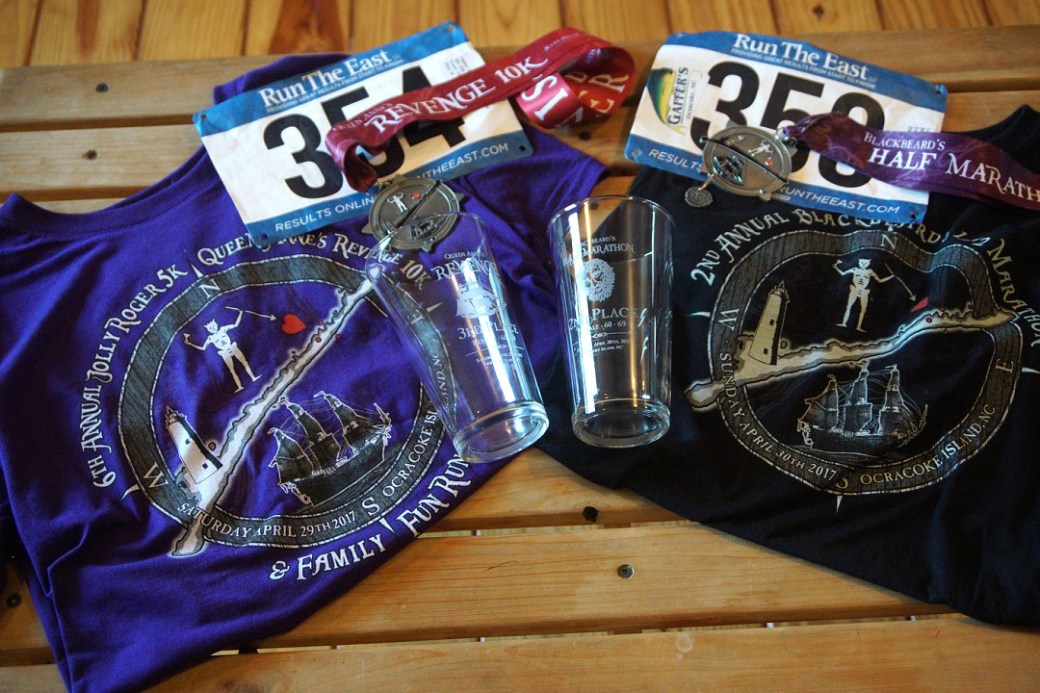
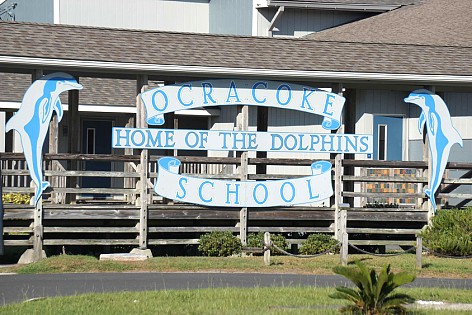 My coworkers have been amazing! There are so few of us– fewer than 200 students in grades pre-k through 12 and fewer than 35 total staff members, including everyone!– that we have to support each other. That includes things like sharing calculators and other supplies, covering for each other for lunch duty and meetings– all the things that good co-workers do in all schools. But it also includes being along the street to wave to me when I am being a leprechaun in the St. Patrick’s Day parade, cheering me on in the recent half-marathon, commiserating over weather and schedules and whatever, sharing family news, worrying about each other.
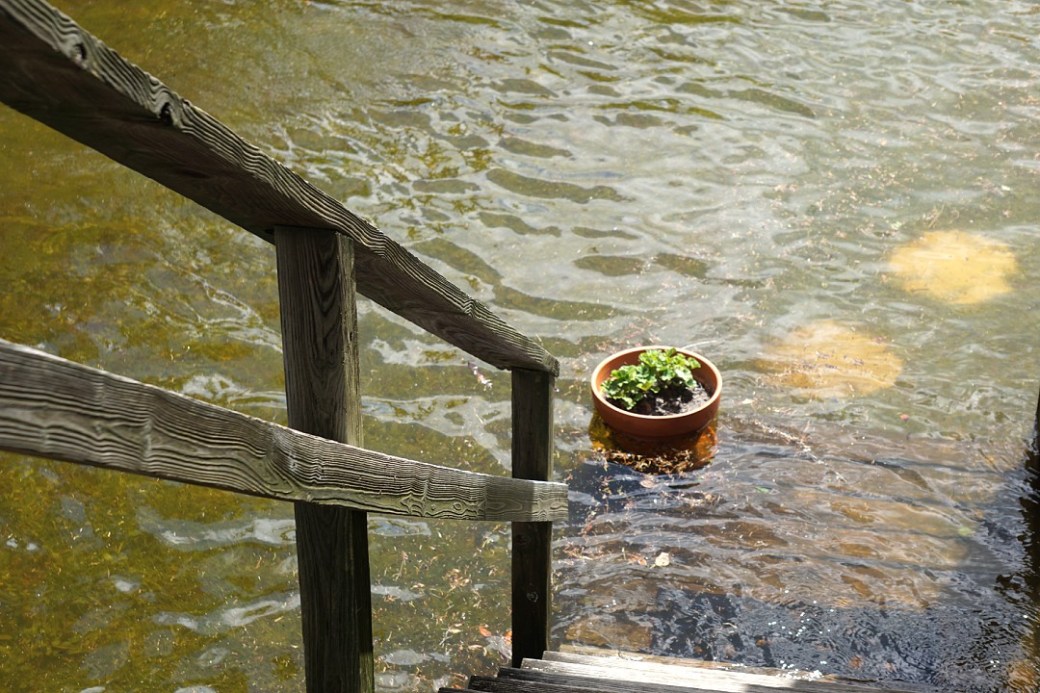 Tropical Storm Hermine, which I weathered here in my little house. The day after the storm came through, I stood here (well, walked around and around while talking to various friends and family members) and watched the water continue to rise– and ever so glad that I had parked my car on the higher ground of the “base docks” parking lot. And then came Hurricane Matthew. Not knowing what the impact might be or how my house might take it, I decided to head west to Lewisville.
 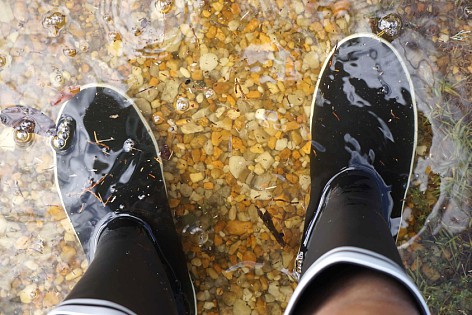 After five nights, I returned to the island as soon as the ferries started running. I parked away from the house again, and made several trips of more than a mile in rain boots to unload what I needed from the car. I was luckier than many. Because my house is raised, there was no damage inside and only a few of the homeowner’s belongings in the downstairs storage room were lost. Power was out for less time here than at some of my family’s in Raleigh, so I lost only a couple of things I wasn’t sure about in the refrigerator and freezer. The island itself– and many residents– were not as lucky.

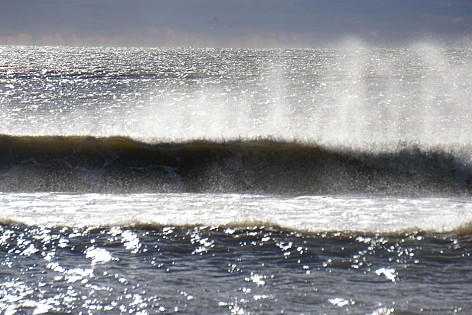 Part of my Skype interview for the job went this way: Them: “You said you have been here; have you been here in the winter?” Me: “No; but I grew up in Boone.” Them: “Then you should be fine. You won’t have the snow, but the winds are brutal.” There was that one weekend when most of the state, including Ocracoke, was in a deep freeze and my heat pump quit working. I woke up on the coldest morning to a house that registered 41 degrees! That, my friends, is cold. But while I was at school that very morning, repairmen came and by the time I got back at lunch the temperature was on the rise. We never really got a Nor’easter, or maybe I just didn’t recognize it as such. Remember, I come from Boone!
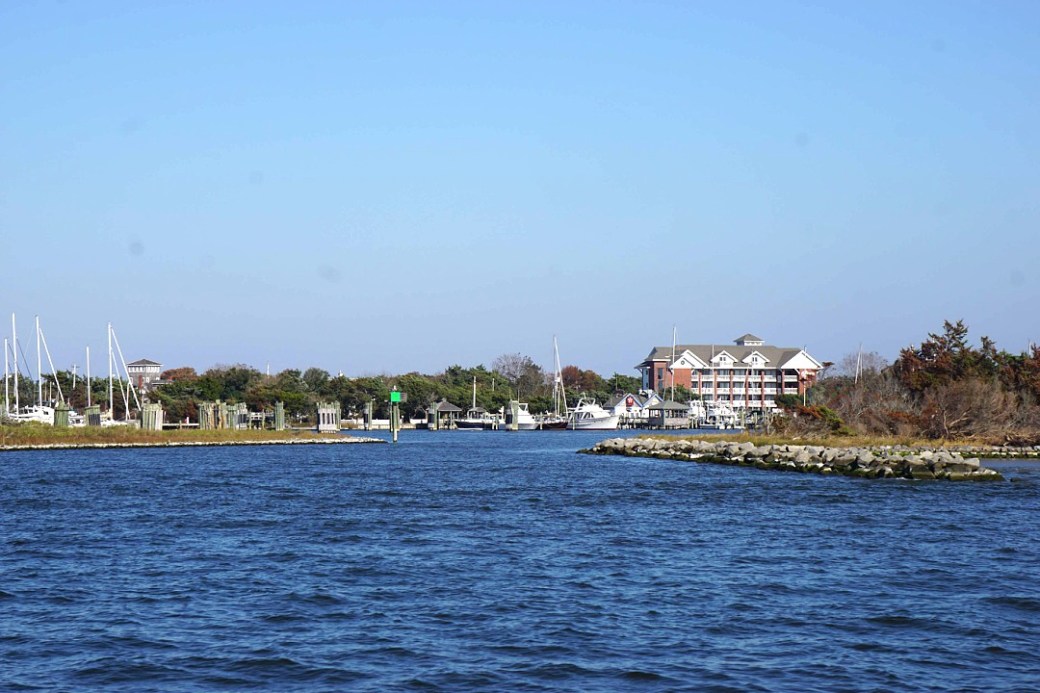 So here I am. Not an Ocracoker, by a long shot. But I like to think I am more than a “visitor,” the polite term for tourists. Folks who move here are referred to as “dingbatters.” In a story about the Ocracoke dialect (“hoi toide”) one man said that his wife, who is from Maryland, is still a dingbatter after 43 years of marriage. So I guess I am and always will be a dingbatter. But I definitely have a reverence for the island and a respect for its people that exceeds that of most visitors.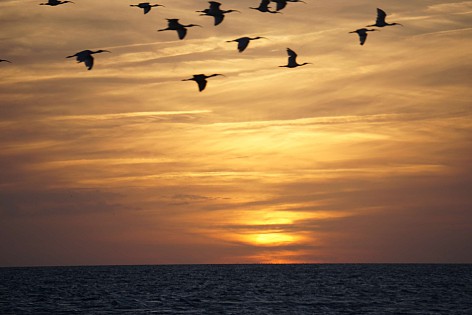


 Recalling how much fun her friend Lucky the Leprechaun had last month, the Easter Bethy decided to spend a day in the village. She was not disappointed!
 Knowing there was no cafeteria at Ocracoke School, EB grabbed a bunch of carrots just in case she got hungry and hopped aboard the trusty golf cart to make the 0.7 mile trip to school. This had been a crazy week at school– Arts Week– with the students involved with visiting artists sharing their talents. There was clowning (juggling, balancing acts, etc.), steel drums, set/props, jewelry; the students put on an amazing performance to culminate the week. Adding to the chaos was an outbreak of strep and flu which affected a lot of our kids.Friday was a half day, leading up to a much-needed Spring Break… so there was no telling what EB would find once she got there.
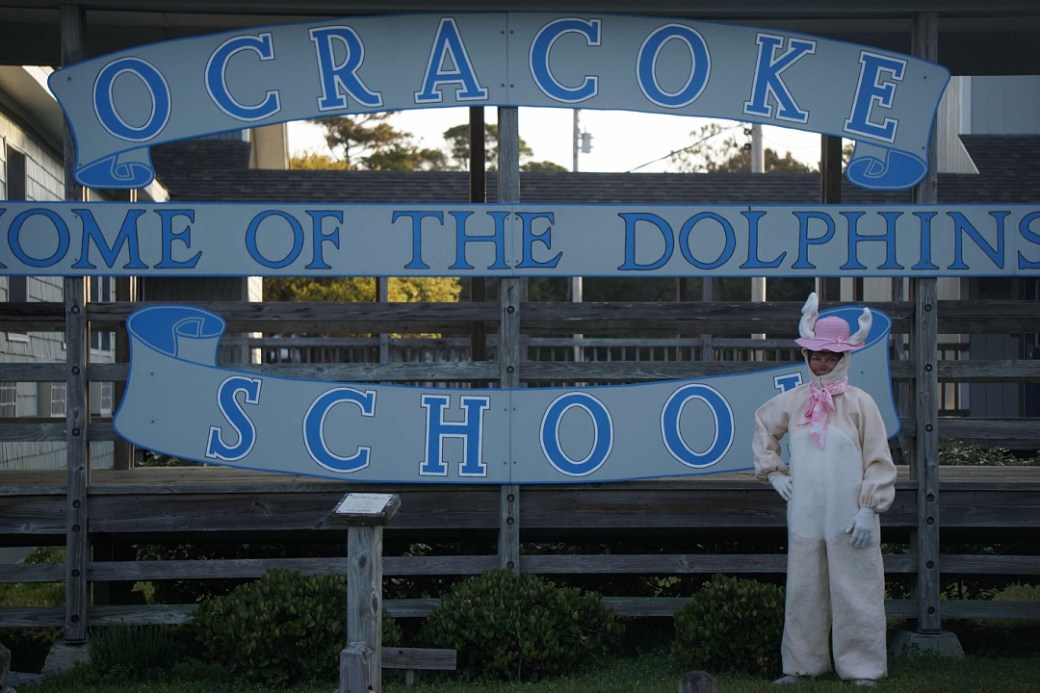 The Easter Bethy’s alter ego AKA Ms. Beth has planning first period, so she dropped in on all the little people (pre-k through 5th grade); seeing these little folks is one of the best parts of working at Ocracoke School. Even lunch duty is (almost) fun! One child noted that it was “the leprechaun”! And one little girl, a third grader who comes to my room for after-school was more than a little uncertain about me! After handing out stickers and hugs, we went back to the room to get ready for serious math business.

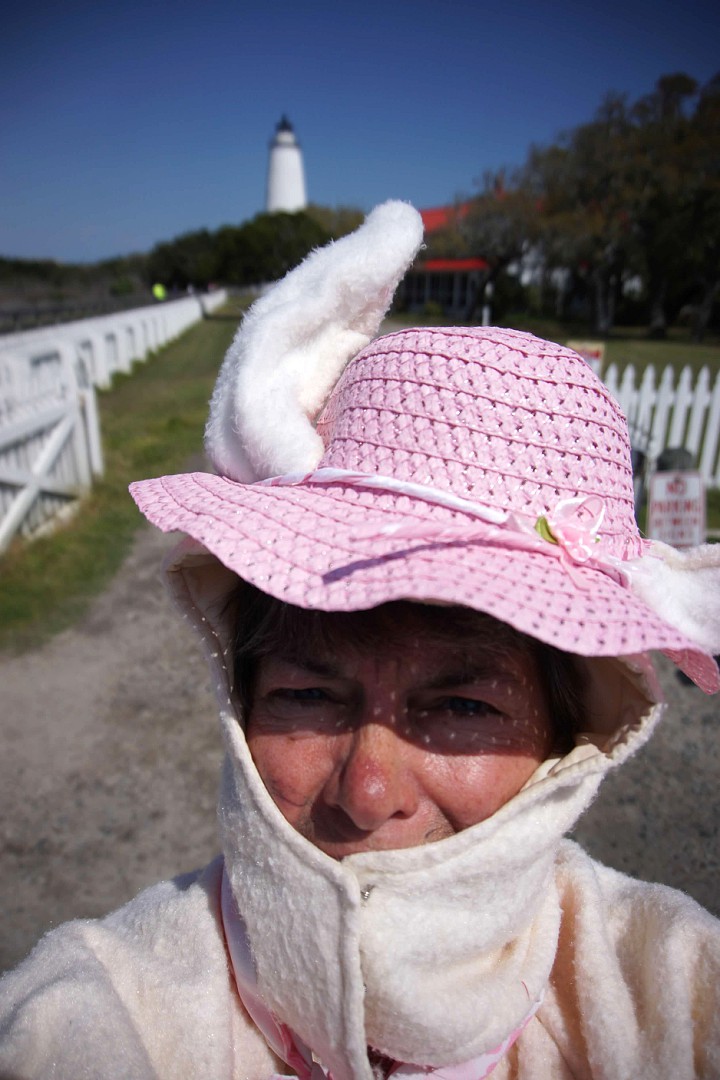 Where else would EB go but to see the lighthouse as soon as school dismissed? No bells, remember. With the three levels of the school all being in two buildings and on different schedules, we can’t have bells. It is entirely possible that a few classes were allowed to leave a couple of minutes early. Well, some were released even earlier. About 20 minutes before actual dismissal time, my kids started getting texts saying they were home already! I strung mine along until 2-3 minutes before the bell would have rung if we had a bell! The island is coming back to life after the winter, and I was not the only person on the road or at the lighthouse. How fun to have people waving at the EB on the golf cart and taking my picture.
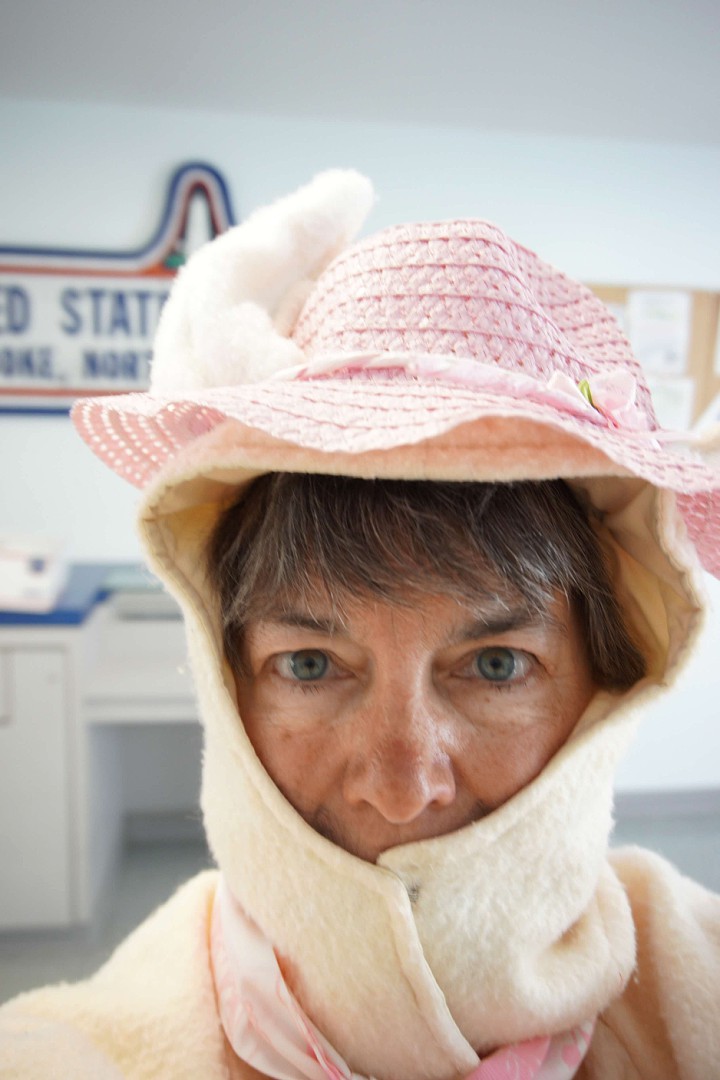 A quick stop at the post office… empty box… not even “Patron” mail… sad EB
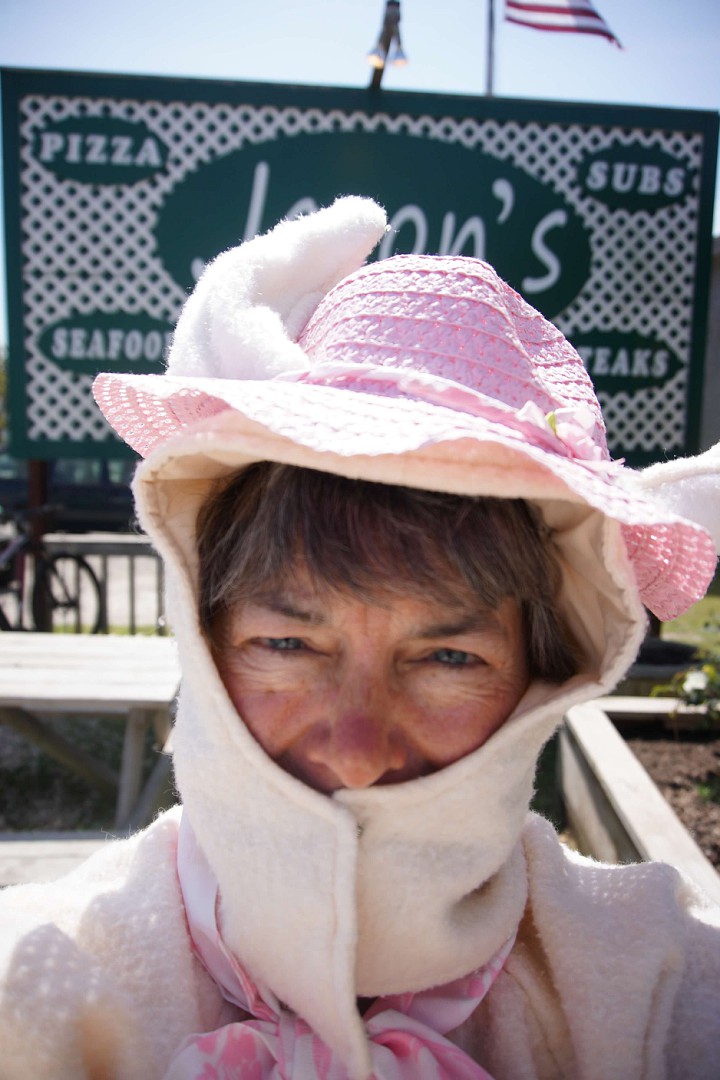 Next stop: Jason’s Restaurant. Nothing like a nice salad topped with homemade– from fresh grilled tuna– tuna salad. With carrots! Perfect to soothe the day’s pain of no mail and no math! Looks like the whiskers are wearing away. EB didn’t have a mirror handy!
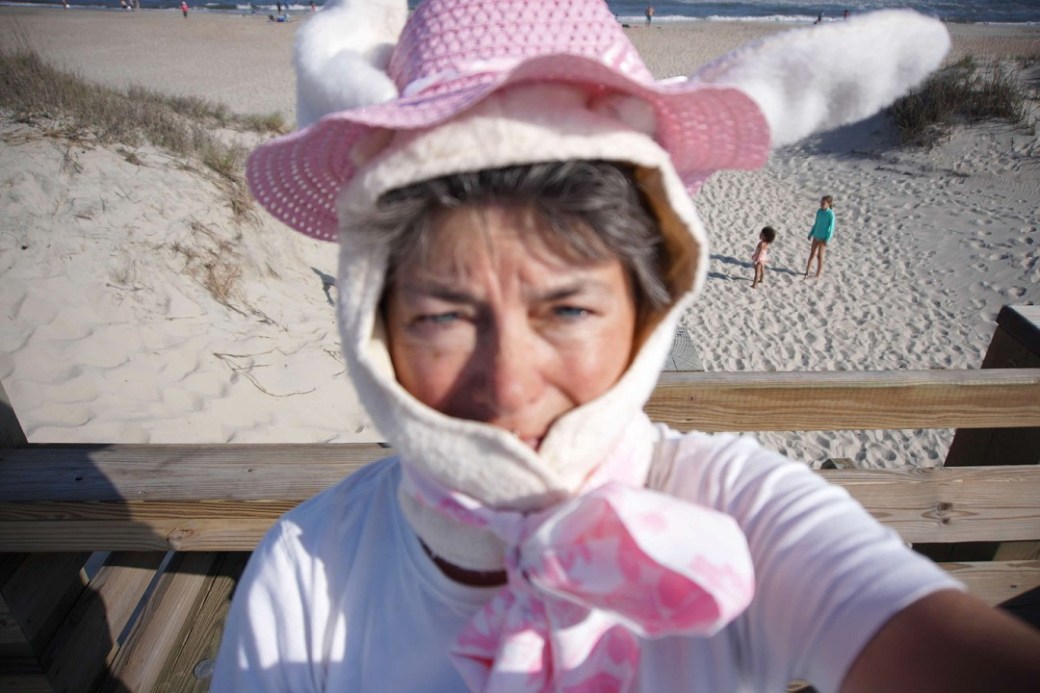 After lunch, EB went back to the house to do some laundry and packing. Spring break just ahead! And then she headed to the beach for a long walk, changing to her cooler attire since summer seems to have arrived early. So many visitors are on the island that EB went to a little further north to walk but stopped on the way home to snap a quick photo at the walkway. Look closely and you can see the ocean in the background.
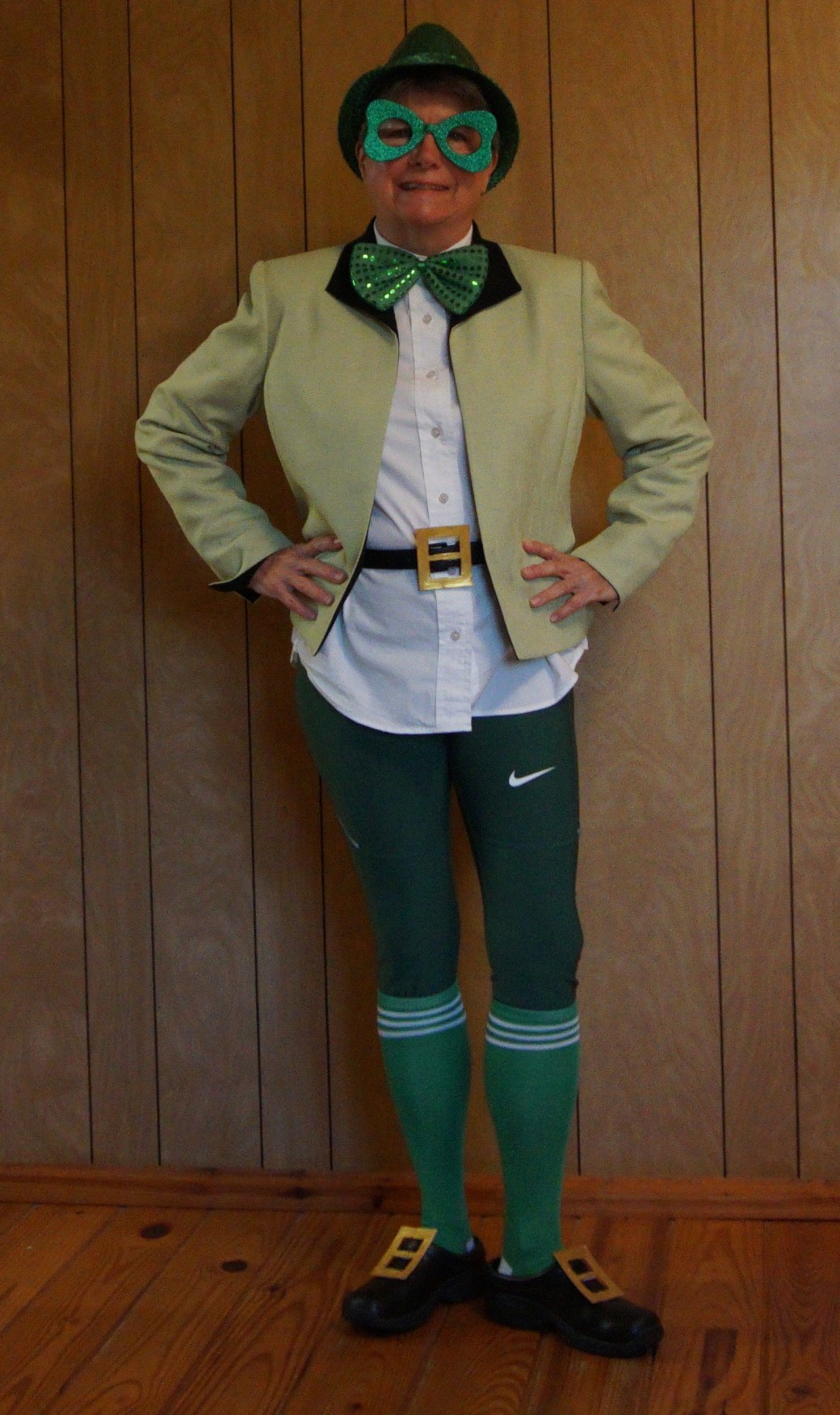 St. Patrick’s Day!
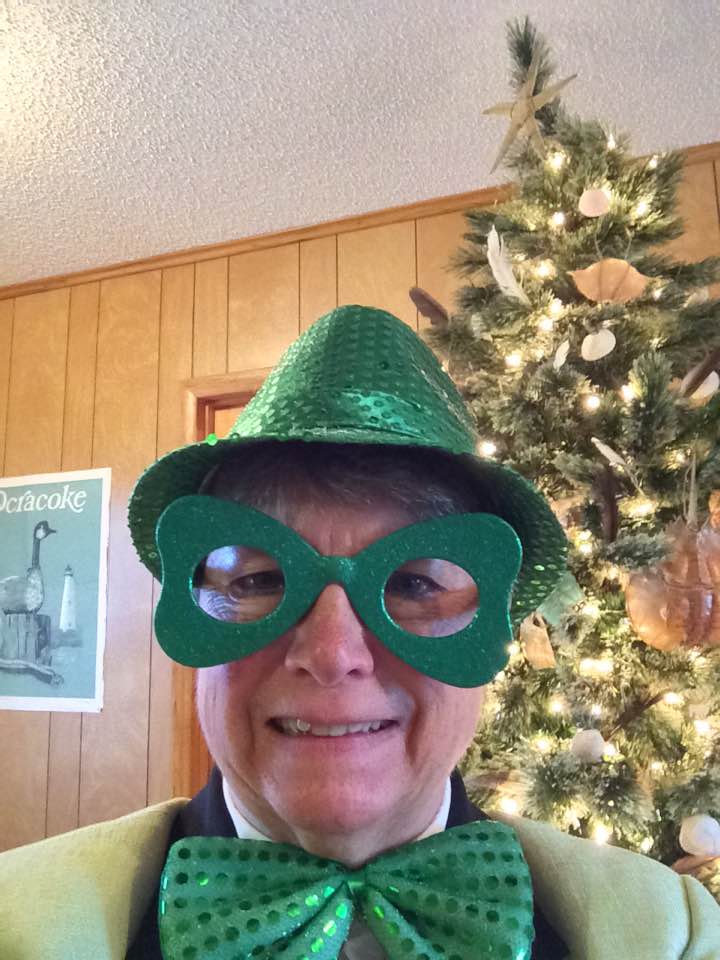 Before leaving home for the day’s festivities, Lucky posed in front of the Sea Treasure tree at home.
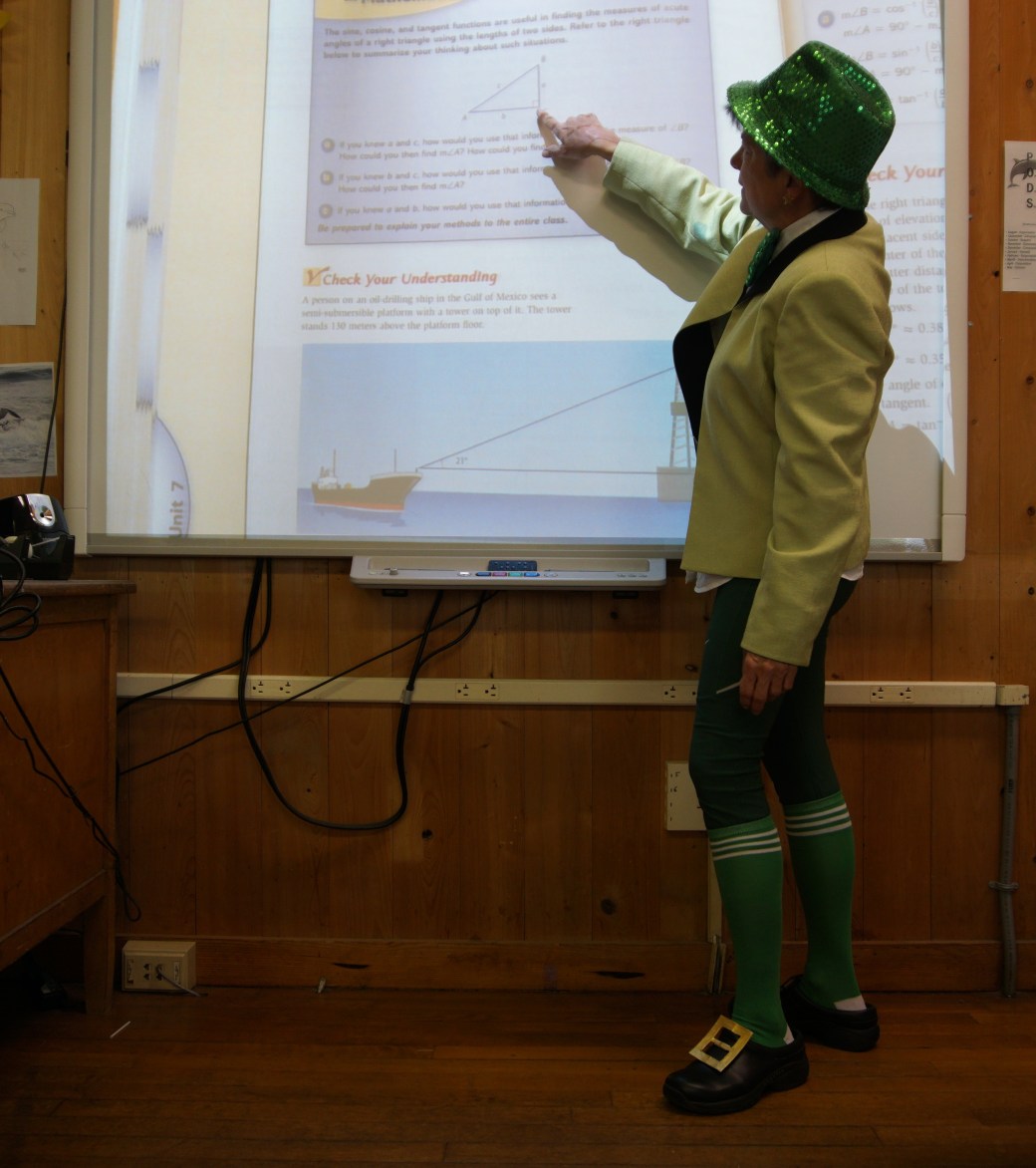 The day really got started with Lucky teaching a little math for our half-day of school. Besides teaching her own classes, she visited all the little ones in the pre-K through 5th grades.
 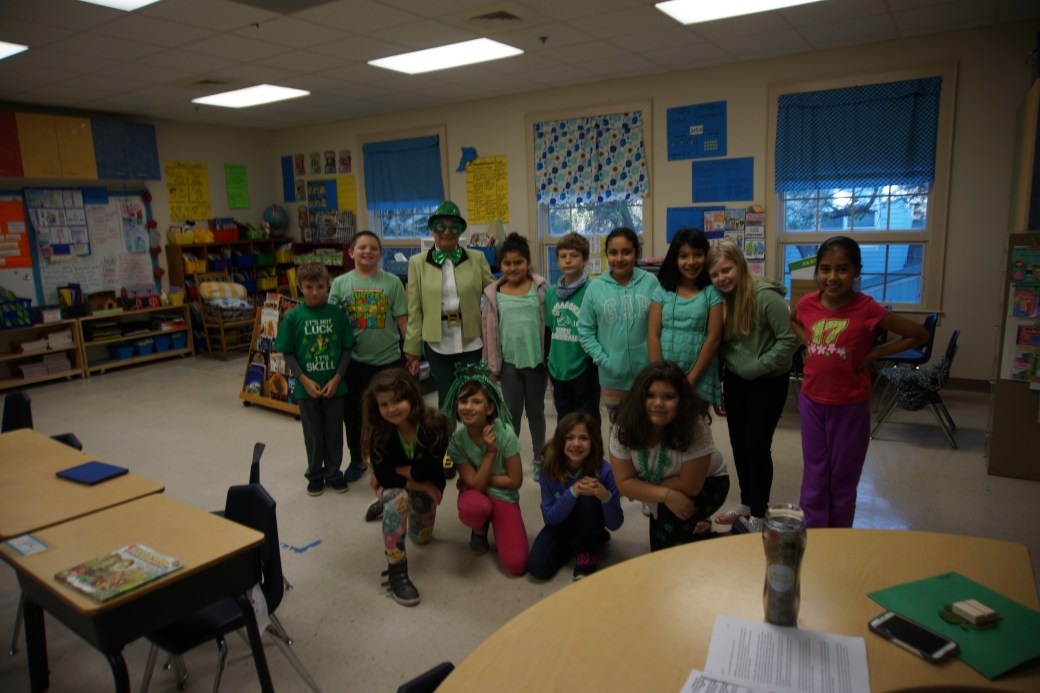 They had lots of stories to share, and I had to confess to some family members who have been known to cause some trouble– turning chairs upside down, messing up papers, sprinkling glitter. A couple of precocious first-graders informed me that I was far too tall (“You are only supposed to be as big as my thumb!”) I told them I was “overgrown,” but should have said I was big for my age! Never having been told I was too tall for anything, I took this as an added bonus to the fun I was having!
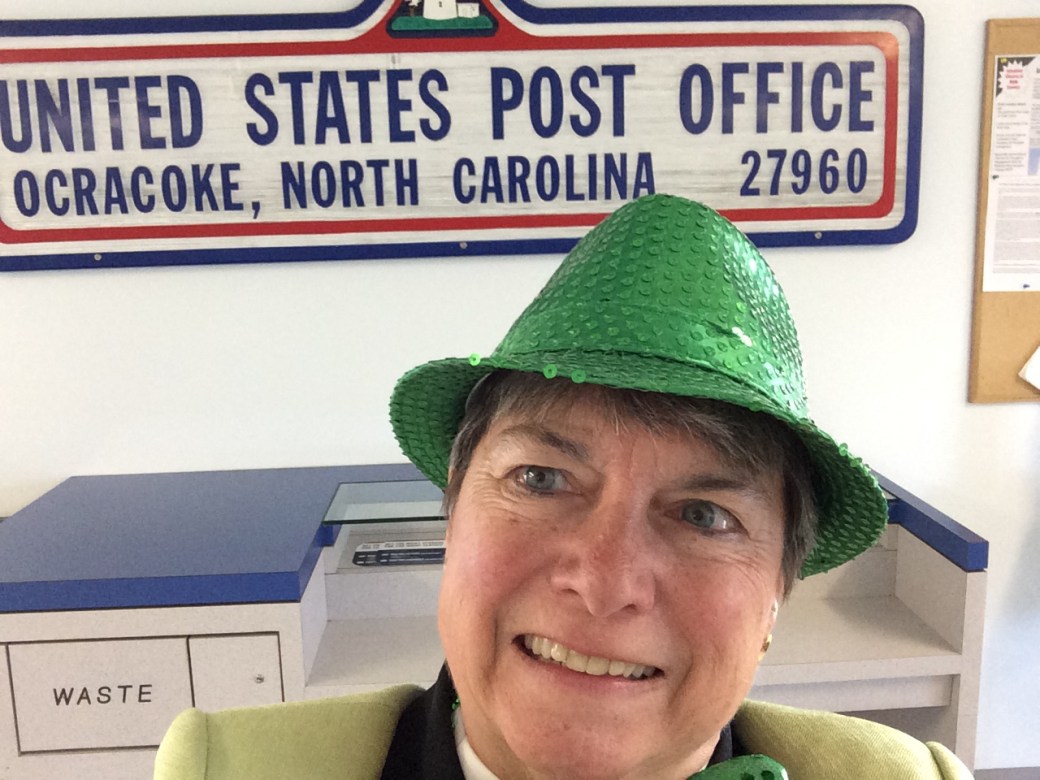 post office,
 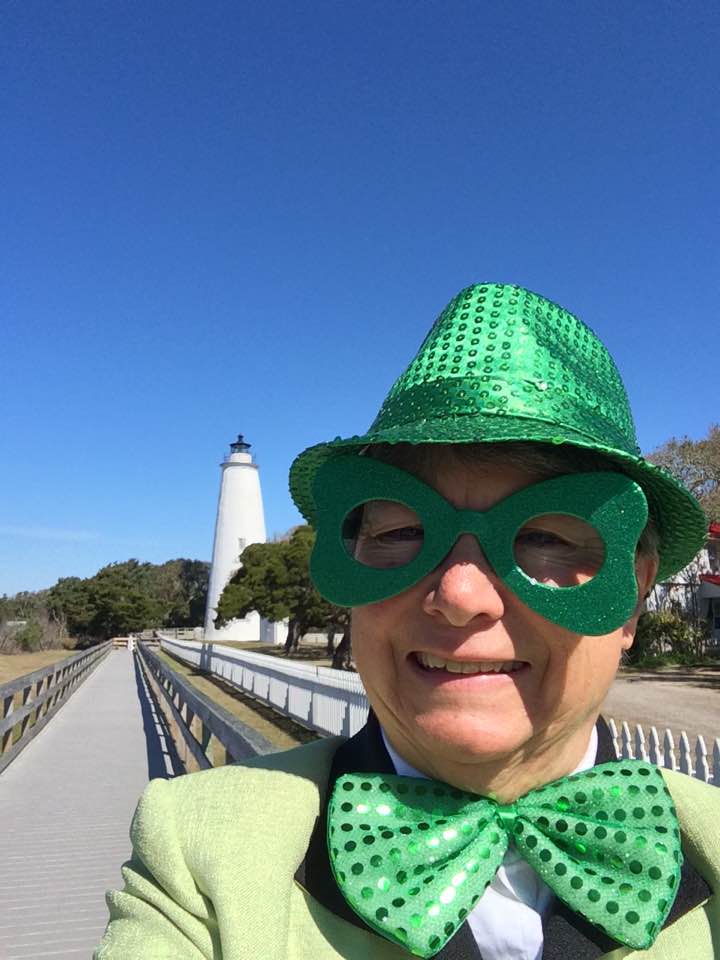 visit the lighthouse, and pick up lunch at
 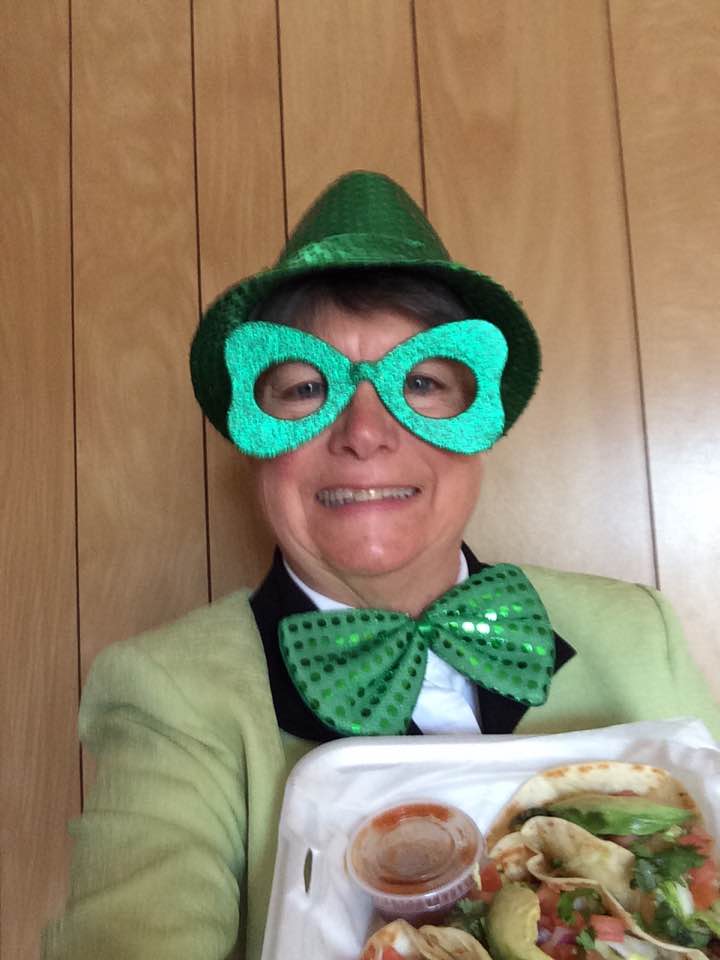 Eduardo’s Taco Stand (Leprechauns enjoy many ethnic foods; one can only eat so much corned beef!) After that there were two walks on the beach,
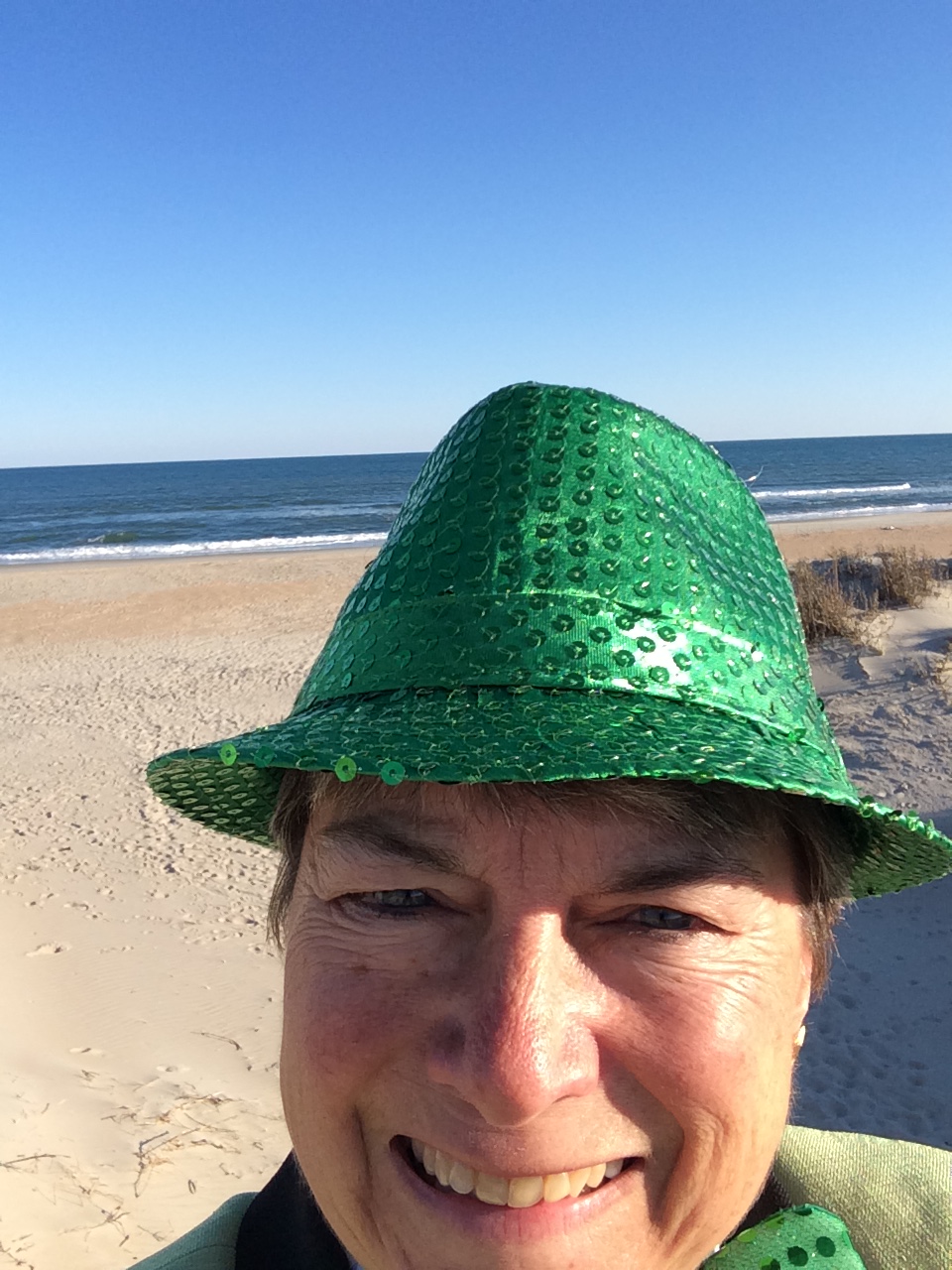 with a quick stop at the first home
 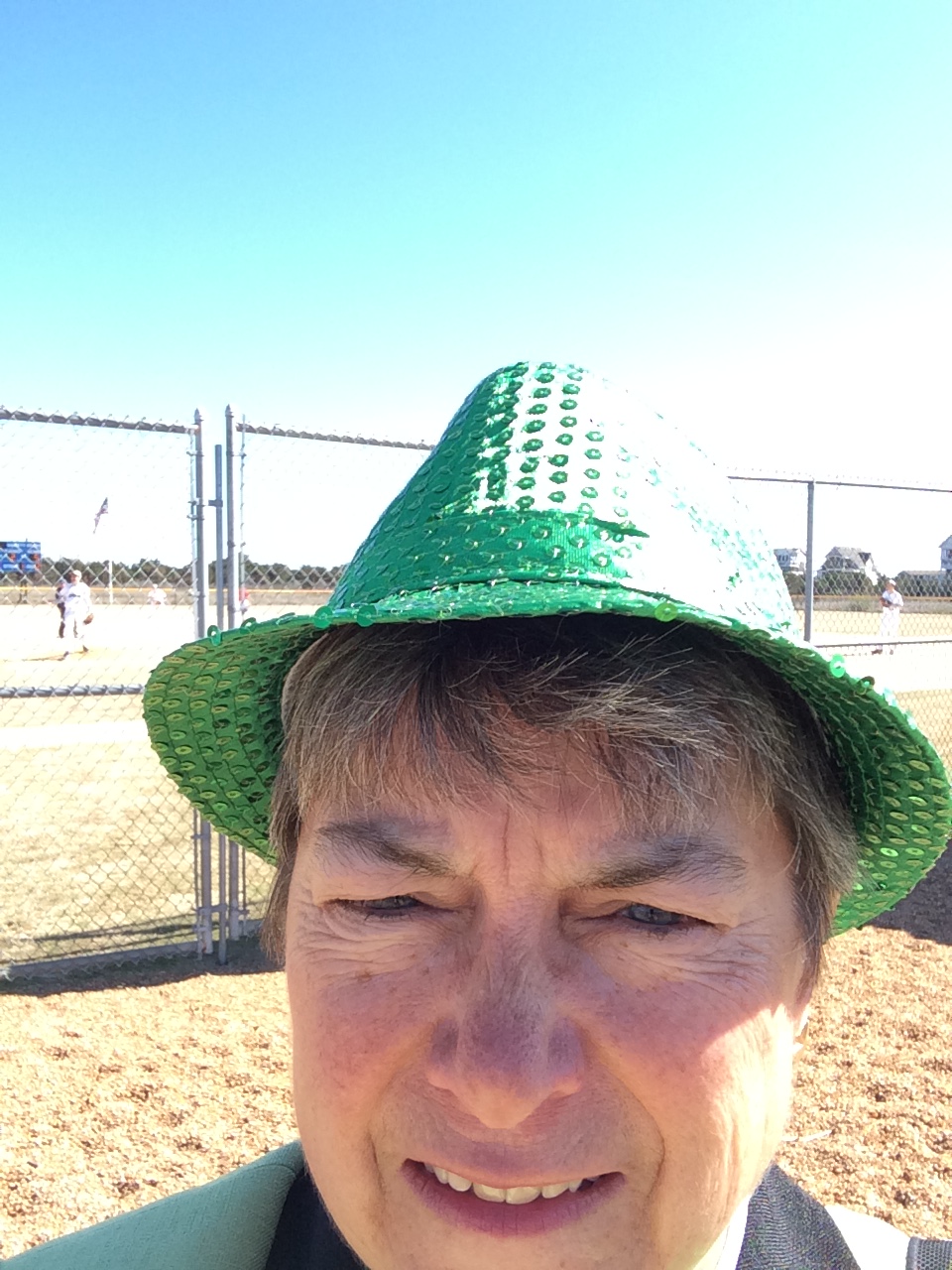 baseball game of the season followed by the second annual Ocracoke St. Patrick’s Day parade. The spirit was great! Last year’s inaugural parade only had four participants and there were at least a dozen this year. Reluctantly I took the golf cart
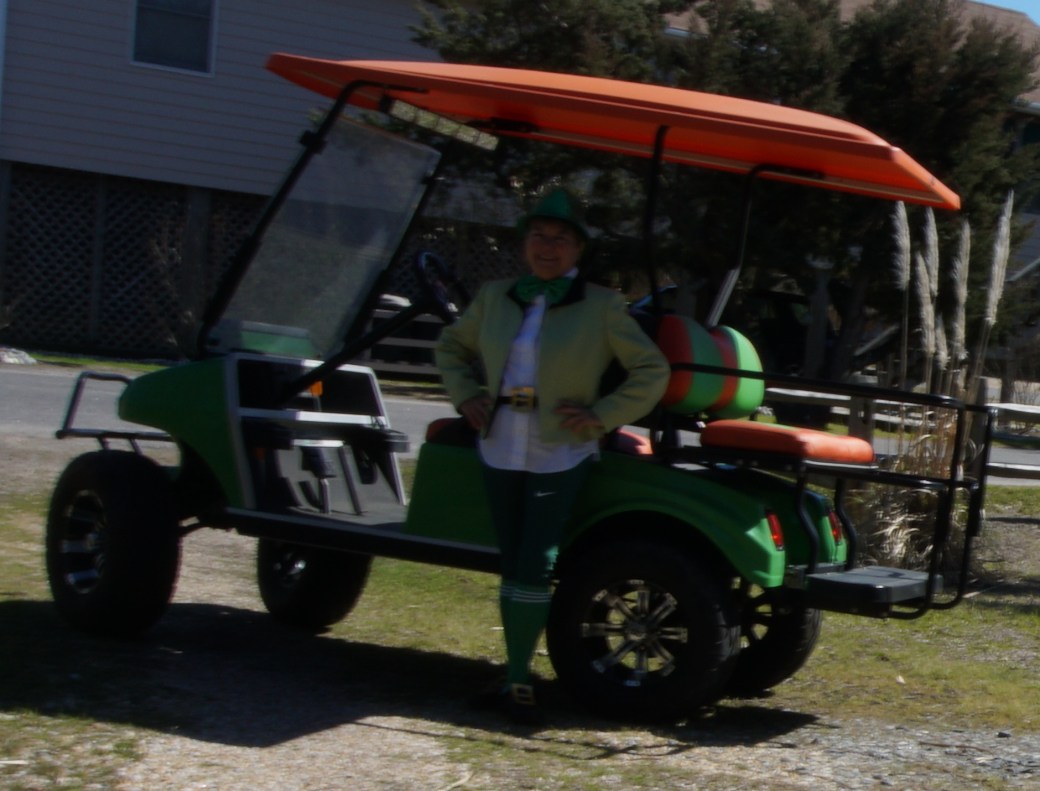 and joined in the caravan. I had planned to just watch; after all, you don’t get candy if you are actually in the parade!


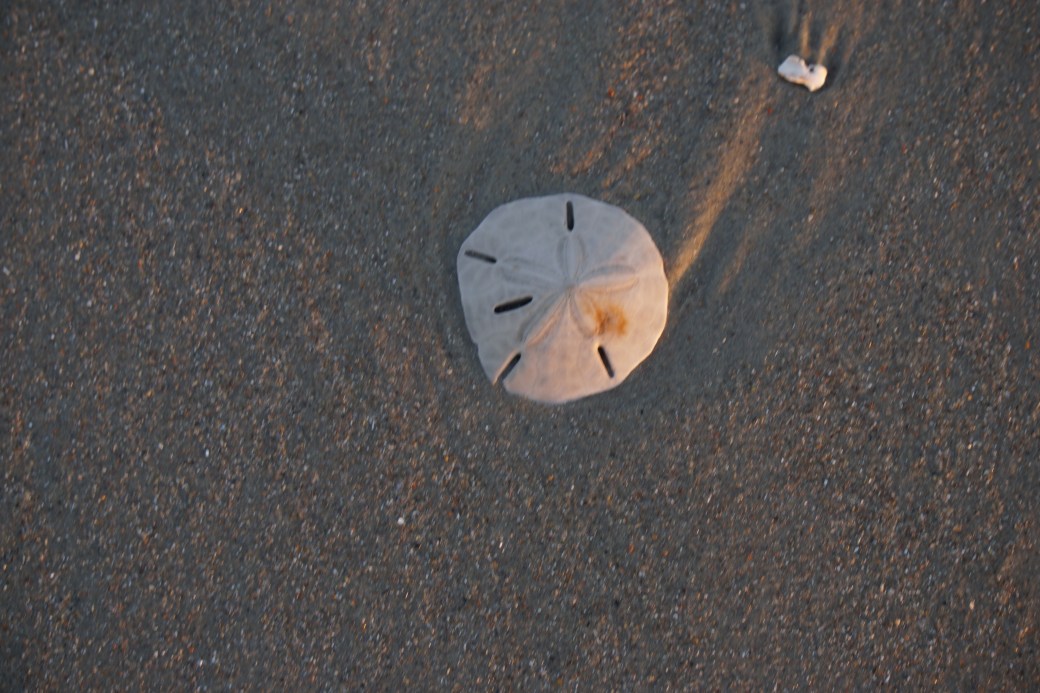 just before I turned to head back to the car.
 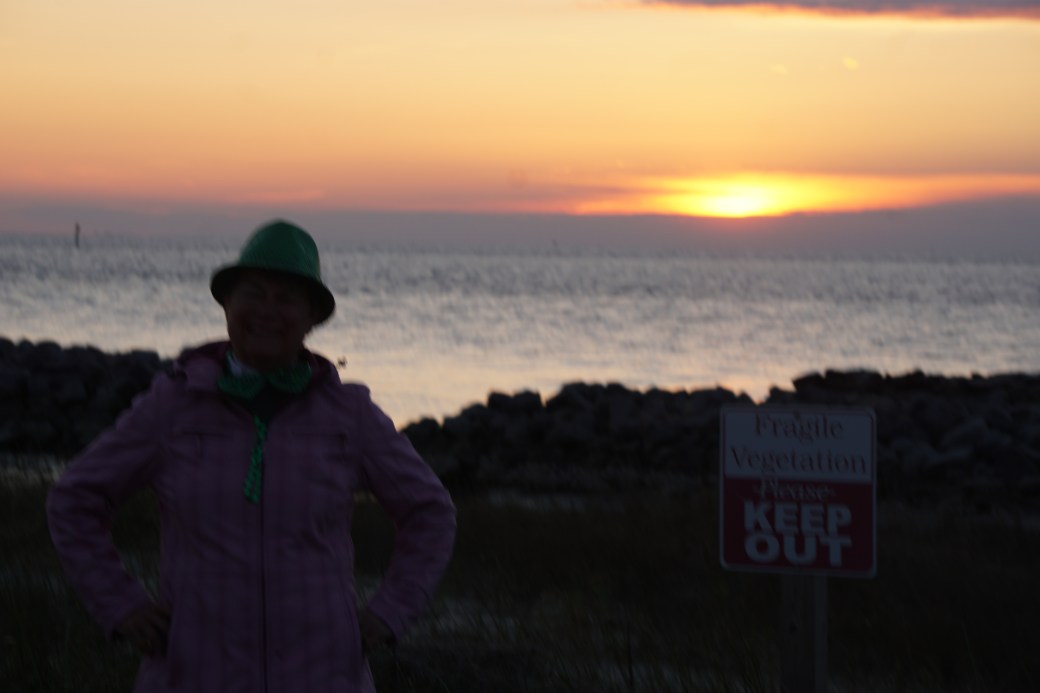 The sun was setting, so Lucky headed for the best spot on the island and pressed a kind
 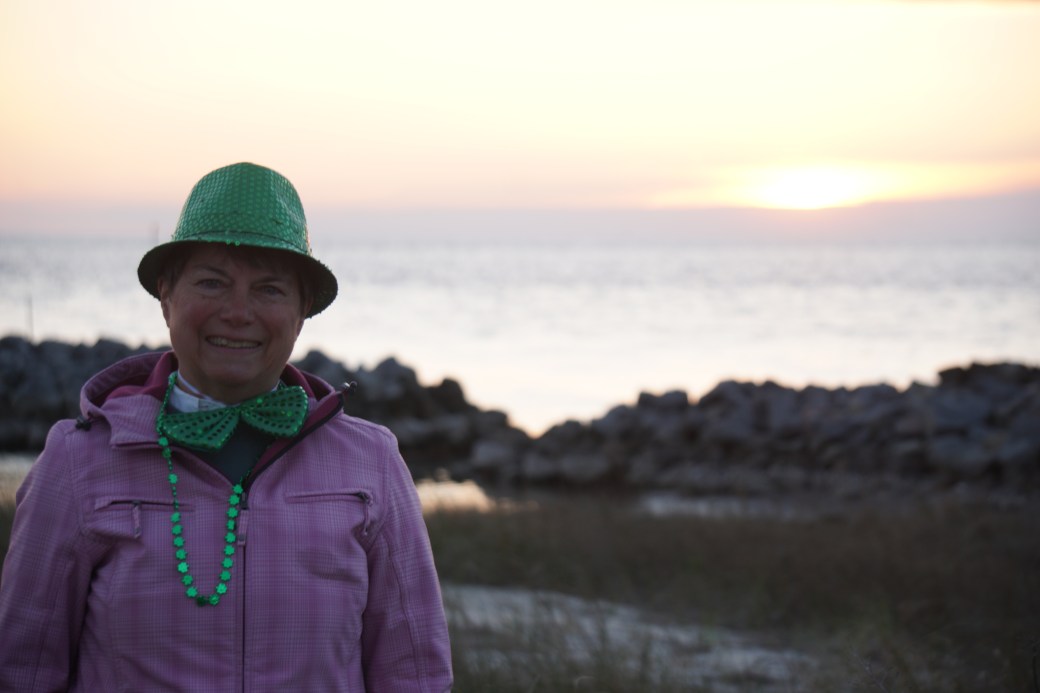 stranger into service for the photo since her phone had died. Then it was home for the evening for a tired little leprechaun!

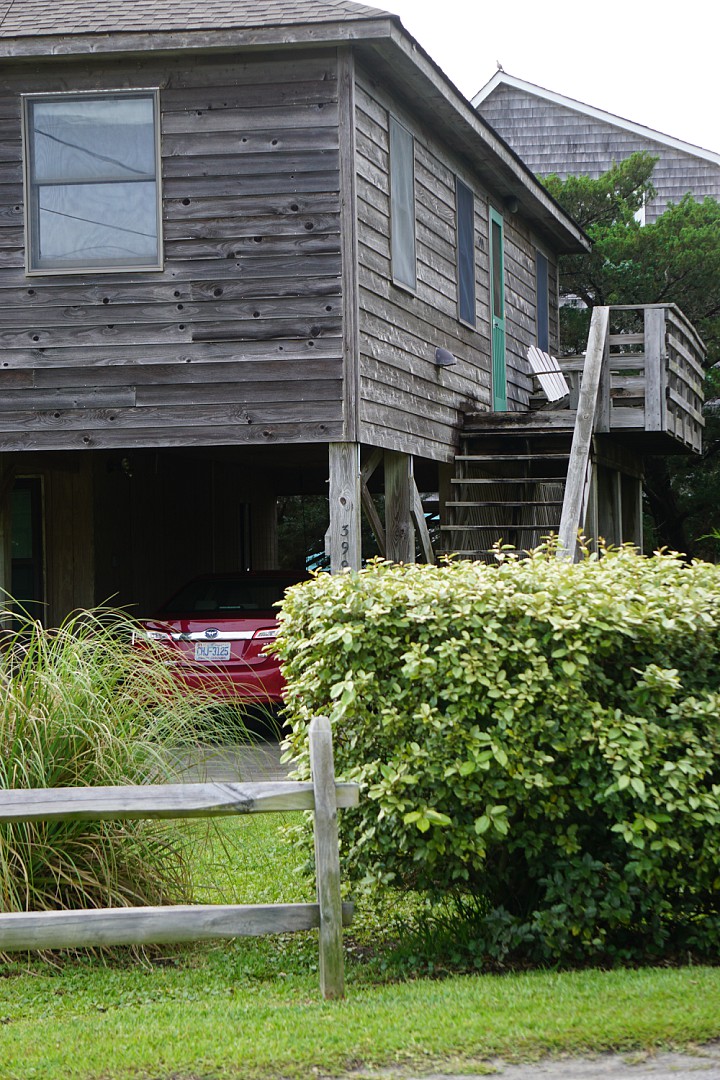 So what is my life like here on Ocracoke Island? Well, I live in a little wooden house, less than one-third the size of our house in Lewisville. And I do mean “wooden”! The ceilings
 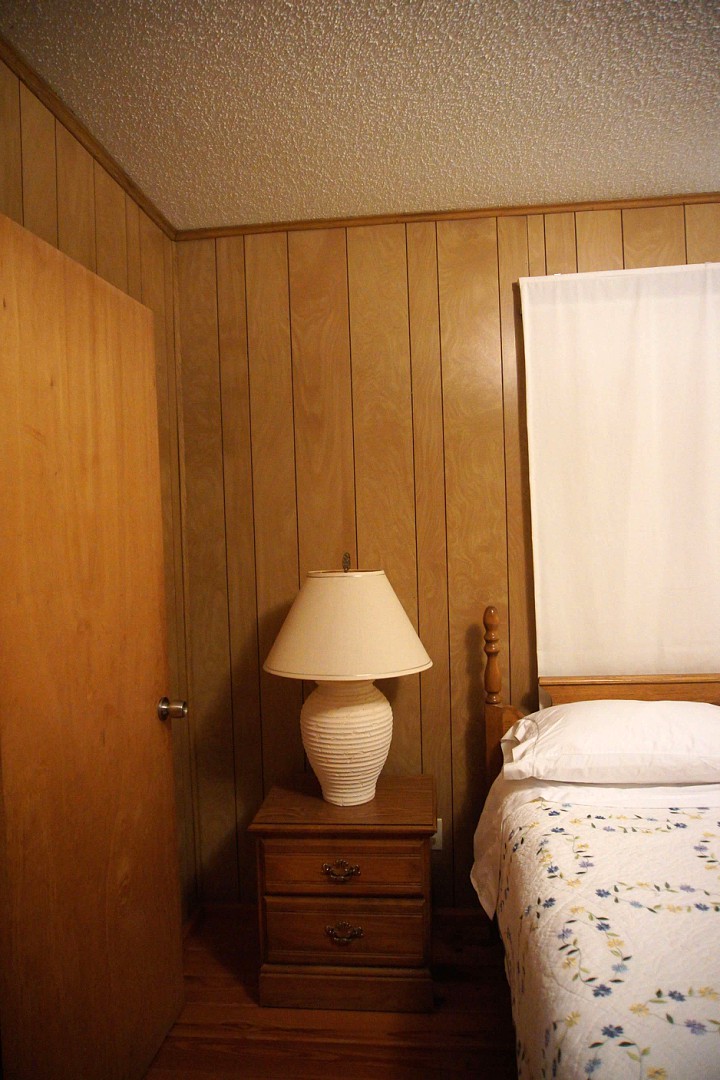 are white but pretty much everything else is basically the same color of medium brown wood– walls, floors, most of the furniture. The yard is large, as yards go here on the island, but grass is sparse. There are lots of cedar trees, an old fig tree, a few live oaks. I
 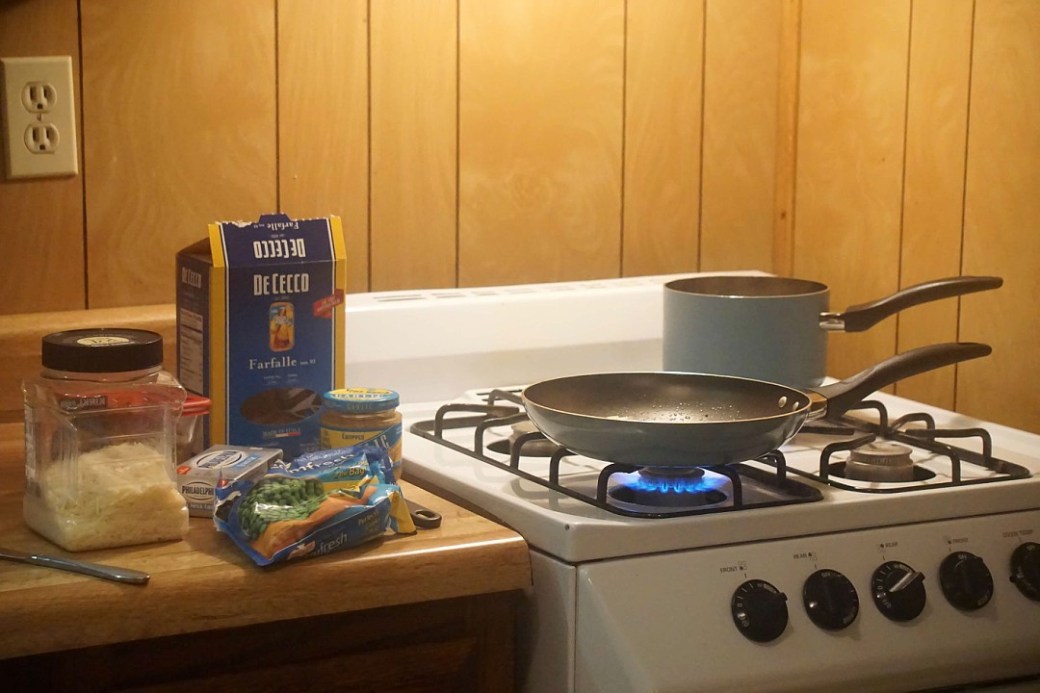 have gotten used to life without a dishwasher and with a gas range. My pantry is the extra
 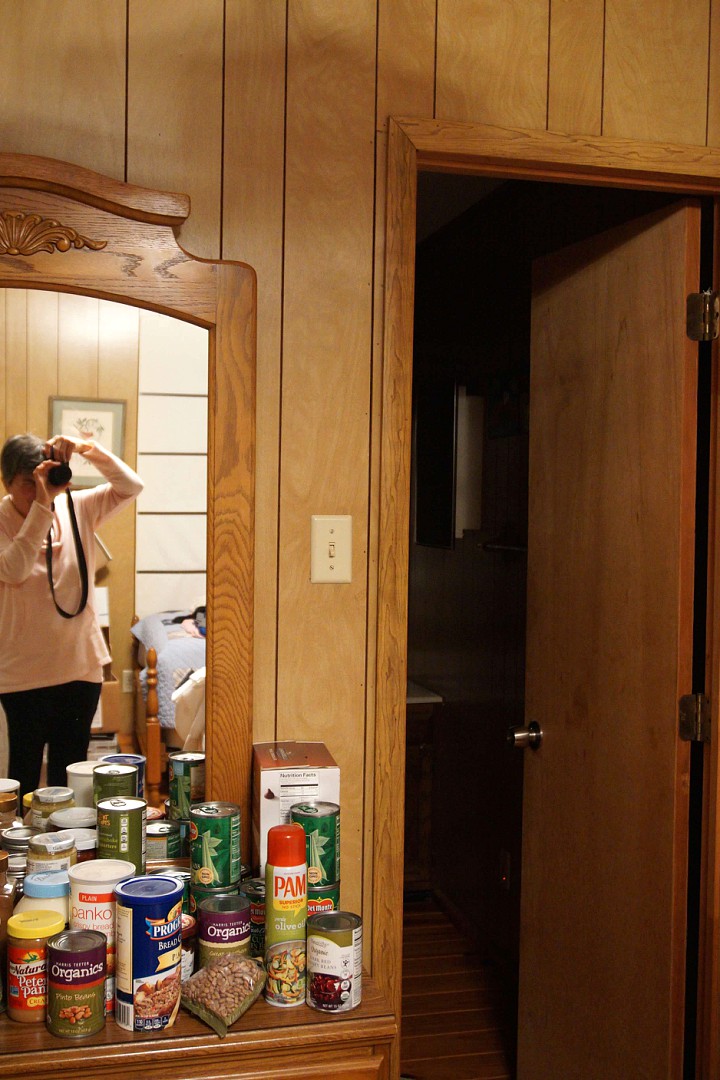 bedroom. (Interestingly, for the first time in my life I have an actual laundry room!) When a grocery run involves a ferry and at least 5 hours (if I hurry!), one plans ahead and stocks up. The local Variety Store has a lot of, well, variety! But prices are high and choices are limited. “Variety” means the number of different items available, not choices within categories! Fresh produce is limited and not always all that fresh.
 School is less than three-quarters of a mile away; I drive most days because lately it has been too windy and/or wet and/or cold for the golf cart or walking. The entire school has lunch at the same time and most of us go home. I have never been able to do that before! Hooray for leftovers! So I get to school early and then, yes, for the first time in my life I leave when the school day is over! For most of my career, I went in early, left late, and took on all the extra tasks. Now, I do everything I need to do to help my students be successful, but enough is enough! Hey, the beach is calling me.
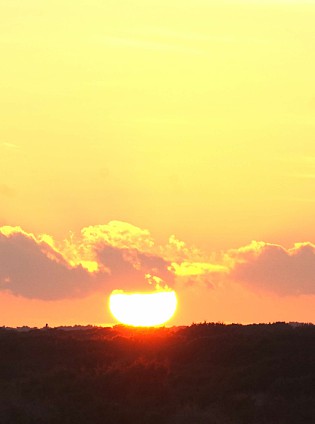 With the shorter days of winter, I generally walk until sunset and then come home to make dinner. Since my children have been out of the house for years and Rick has always worked evenings, this is not much of a change. While I have made lots of friends here and there are plenty of people I could call on if I needed to, they mostly have families here and things they have to do. I don’t mind the solitude, but I guess you could say I am “set in my ways.” I walk, cook and eat dinner while watching the news and Jeopardy, maybe do some laundry, read, … and yes, I feel sort of guilty that for the first time in nearly 35 years I am not responsible for anybody else’s dinner/laundry/day! Which is not to say I don’t wonder about and pray for all of those for whom I used to be responsible!
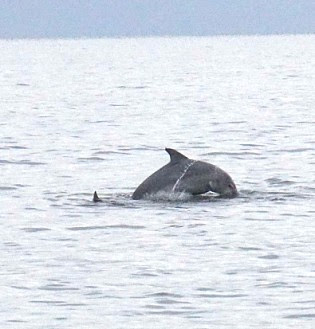 Life is different on Ocracoke in the winter. Quieter, calmer. My schedule is not that much different, except that I don’t get to walk as long because of the shorter days; but it is still somehow different. One of the first things I noticed is that I can hear the ferry horn from the house and from school. There is always one long blast upon departure; but whether it is climate or crowd, we don’t always hear it in the busy seasons. The beach is even less crowded; often I walk for an hour or longer and do not see another soul. Traffic of all kinds–vehicle, golf cart, foot– is sparse. Even on warm days, the wind can be fierce. But I have always been a person who loves the seasons and all the changes they bring. So Ocracoke in the winter suits me just fine.
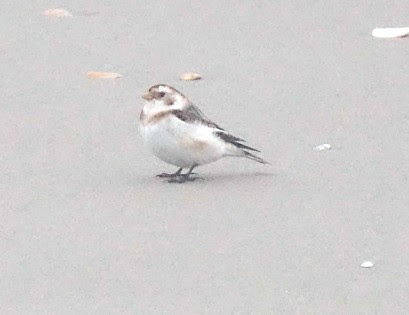 And this season of my life also suits me just fine. It isn’t perfect, but neither am I.
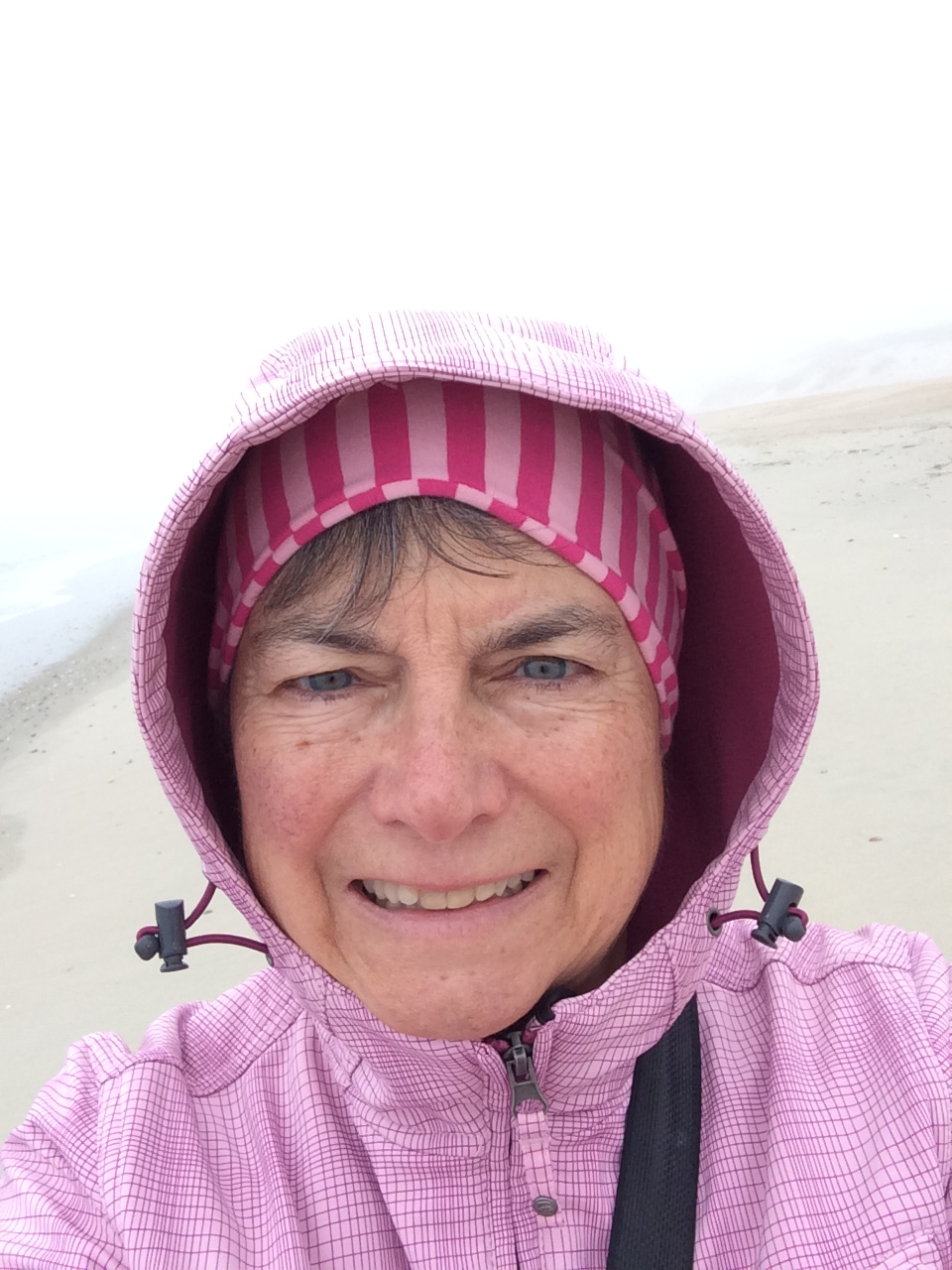 So here I am, a week after I started this post. I think part of the problem is that January is not really the start of a new year for me. For as long as I can remember, with the exception of a couple of years in research, the real start of a new year has been August. Because if you are in school, have children in school or teach school, we all know that is when the real new year starts. (Apologies to those on alternate school schedules!) August is when you get your eyes checked, go to the dentist, see the doctor, buy new shoes and school supplies (ooh! look protractors and notebook paper are on sale!), get a haircut. And a new year starts.
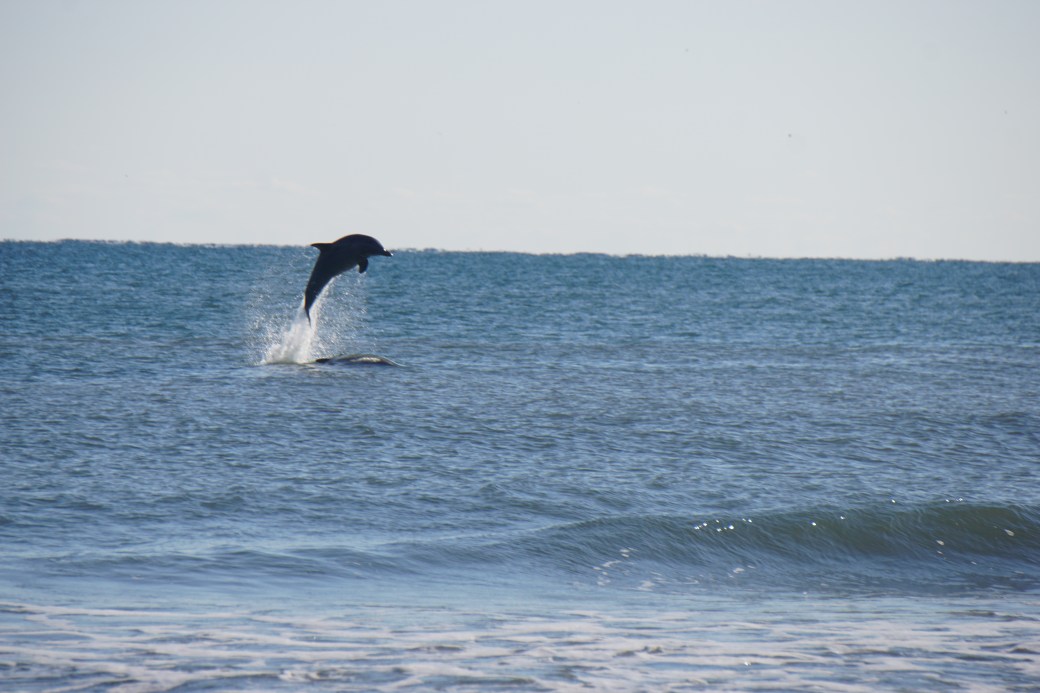 This is a year of discovery for me. A year of quiet and solitude. A year of meeting new people, new things head on. A year of unknowns. New experiences. Ferries. Six hour trips to the grocery store.Gulls and pelicans. Sand always between my toes.
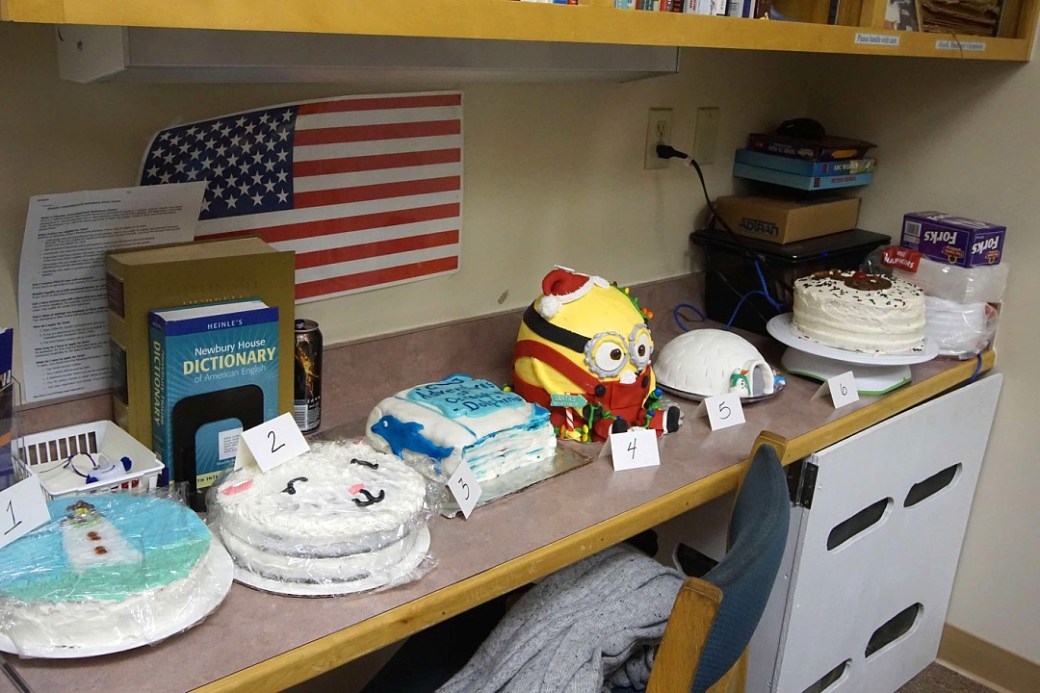 There was a cake decorating contest at the library which is shared by the school and the community. My lighthouse cake did not win; but lots of people said it tasted a lot better than the professionally decorated Minion cake! I am okay with that.
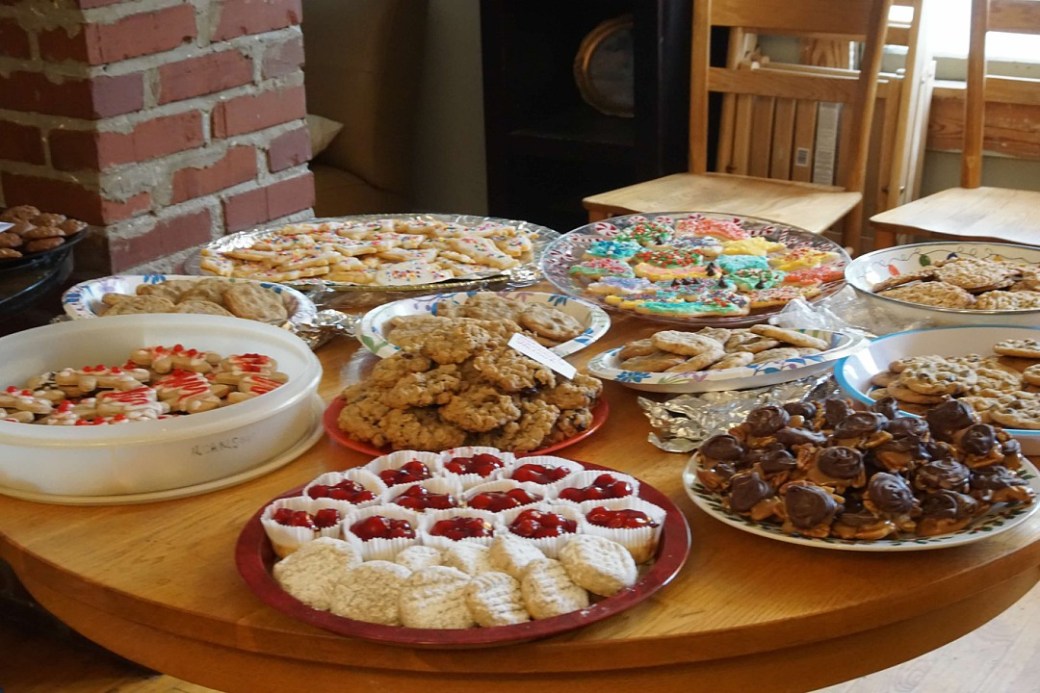 the golf cart –seemed only fitting!–and took my adaptation of the Ocracoke Island Fig Cake recipe, turning it into cookies! Other events included open house and tree lighting at the Ocracoke Preservation Society/Museum; a school Christmas program and a community Christmas Concert (I missed that, but I have seen video of the little Girl Scout troop’s ukulele performance! Does my heart good.) The school hosts a holiday basketball
 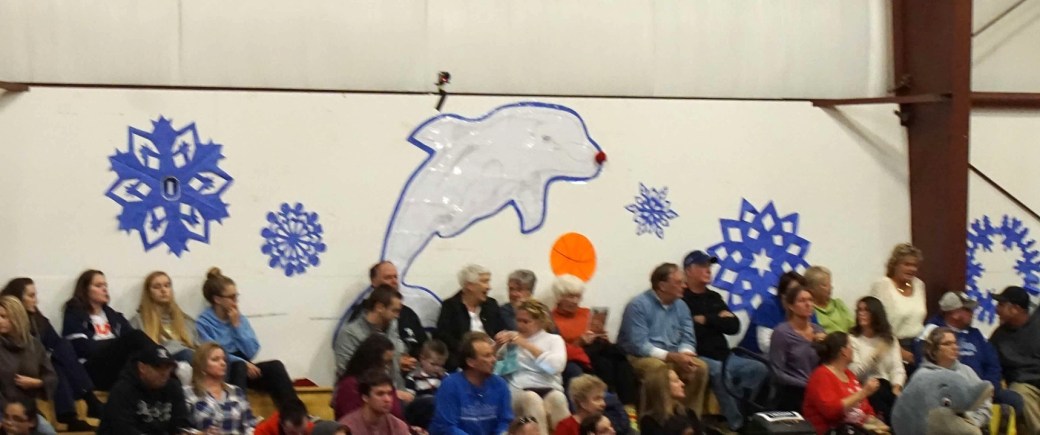 tournament, and my students created a big scaled-up drawing of a dolphin to decorate the gym. And Santa– who knew that I was “the new math teacher!”– came to the Variety Store!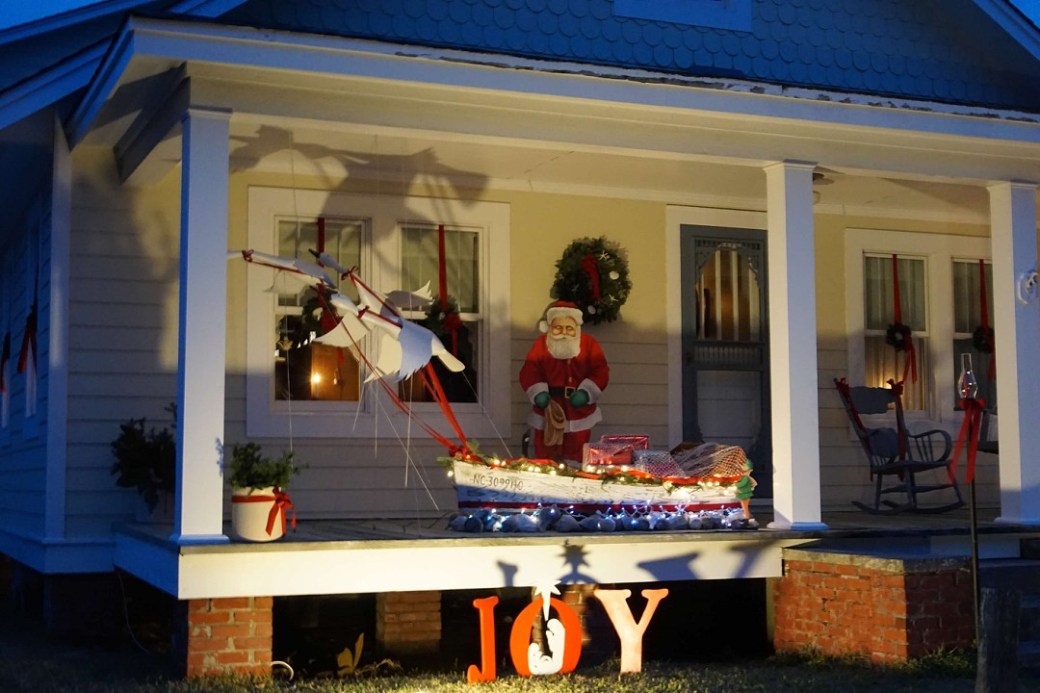
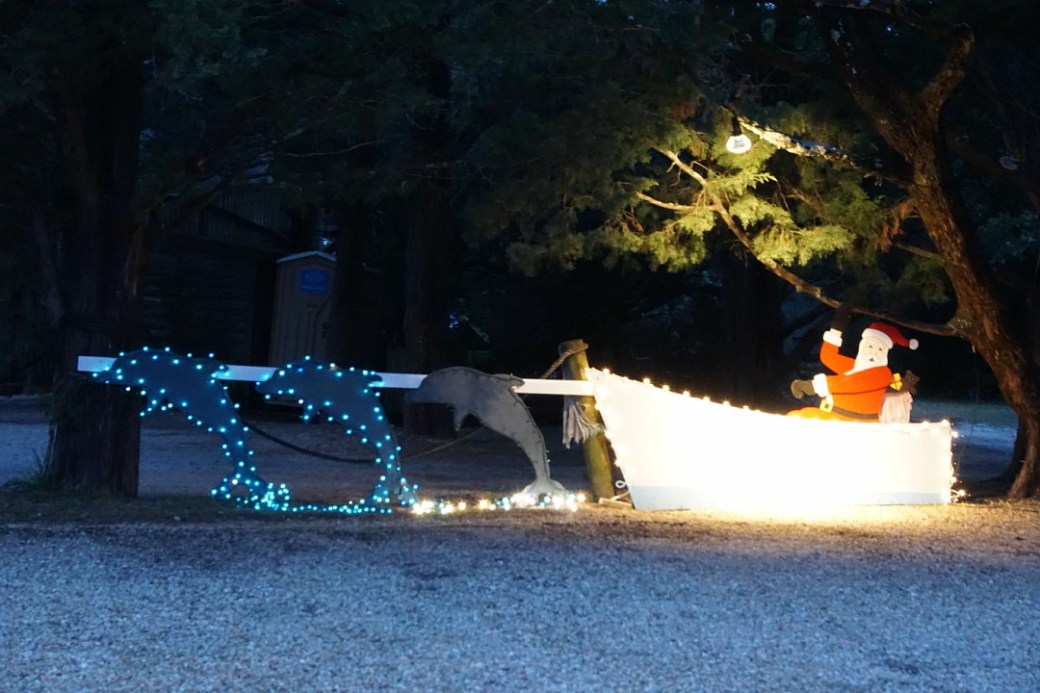 There is a holiday decoration contest and so many houses get into the spirit! And Santa gets help here from the traditional reindeer, but also from tundra swans and dolphins,
 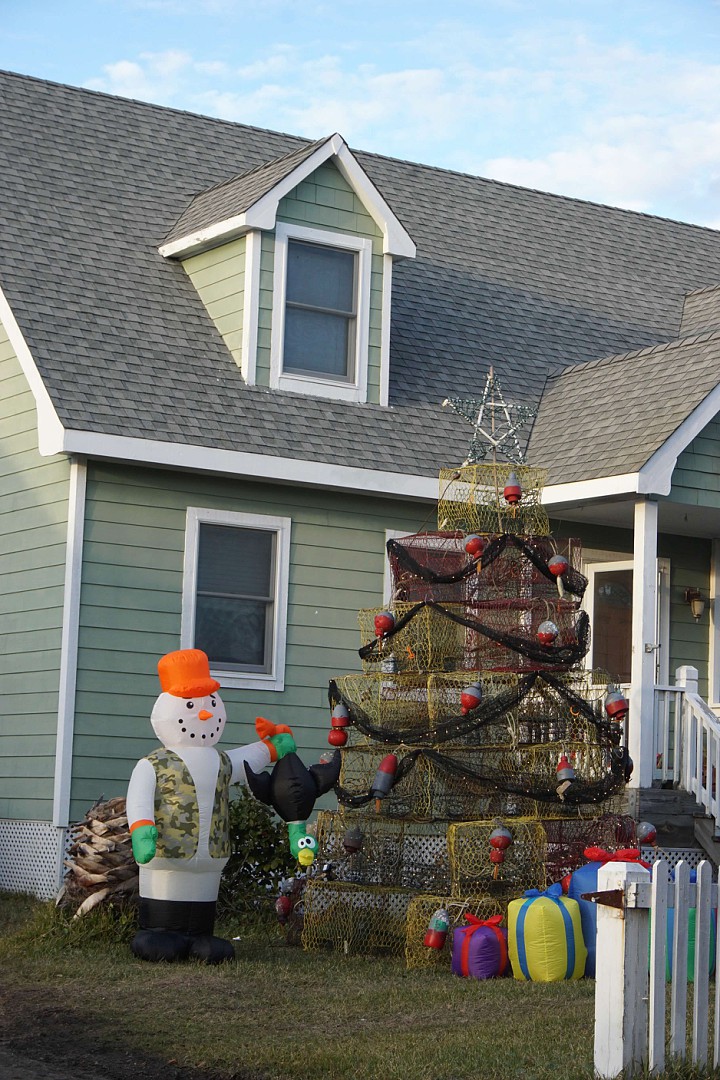 too. Trees might be cedar, or live oak, or crab pots. Yes, crab pots!
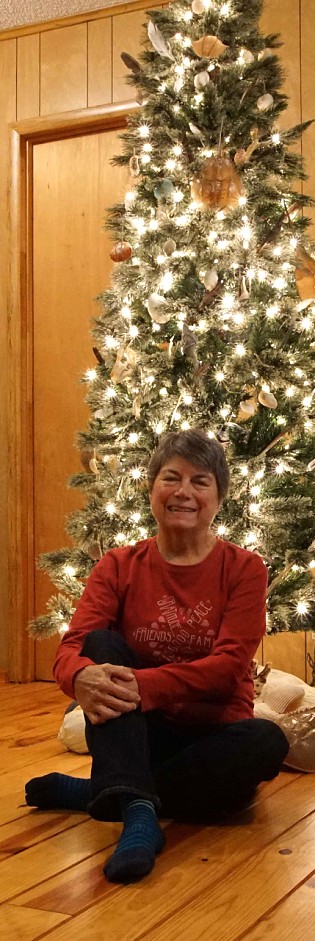 My own tree is decorated with treasures from my walks on the beach– seashells, bird feathers, horseshoe crabs, a few bits of driftwood and sea glass. Just like when I am Lewisville, I turn off the other lights and sit in front of the tree and just … I just sit and think and reflect. (It looks particularly pretty in a foggy sort of way when I take out my contacts and the light is diffused! An advantage to being very near-sighted!)
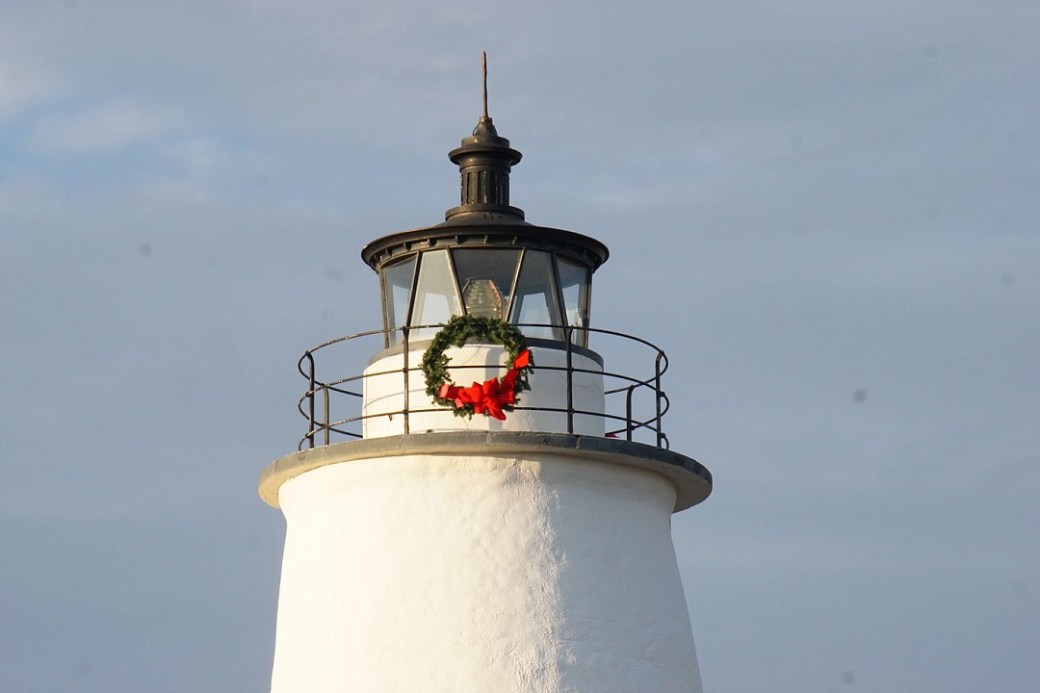 And my beloved lighthouse gets into the spirit with two simple wreaths, hung by the son of the last lightkeeper before full automation. One can be seen from the village and one from the sound. Such a sweet reminder of how little we need to celebrate this beautiful season. I knew it was Christmas when the wreaths were hung.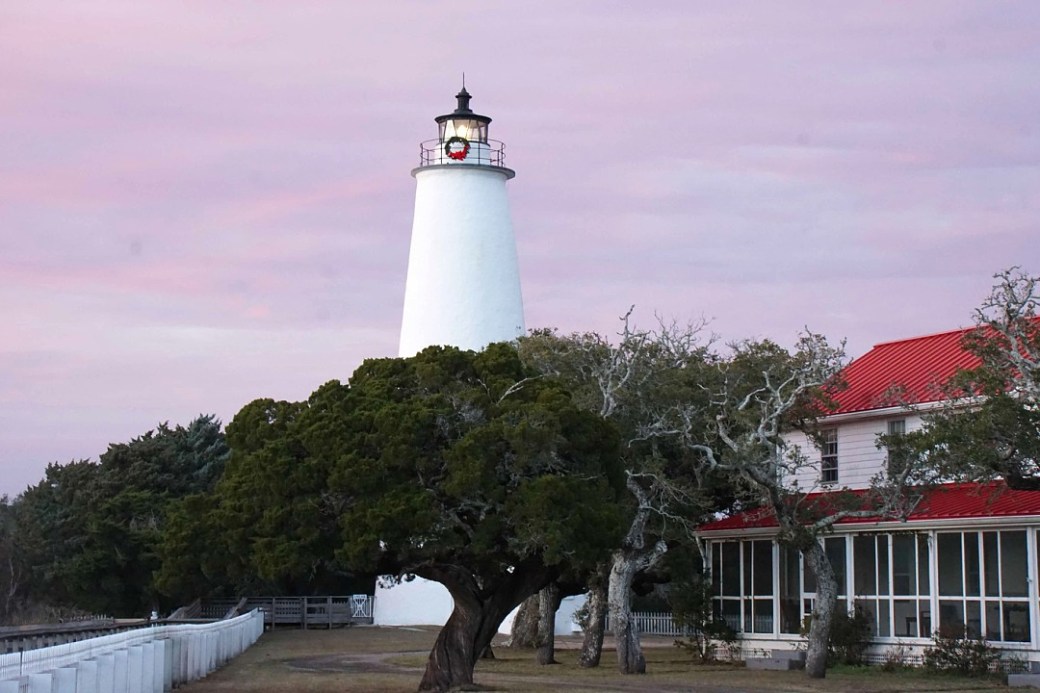
 bethdlayton